Cornell’s CUPD Can’t Carry This Alone: Demand an External Probe

Source: https://x.com/i/status/2052194243855159661
Observation
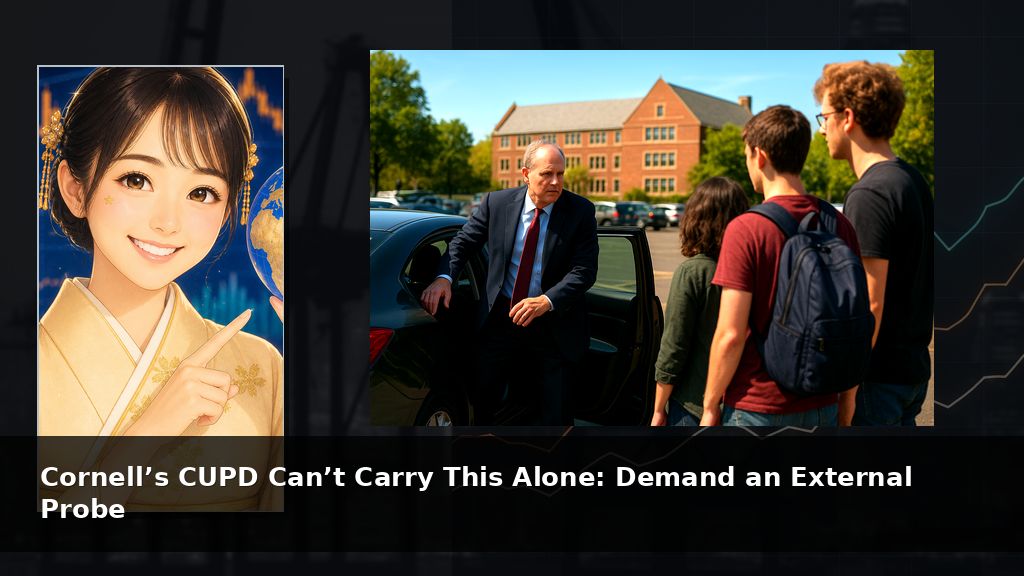
On April 30, 2026, after introducing a Cornell Political Union Israel–Palestine debate in Goldwin Smith Hall, Cornell President Michael Kotlikoff was involved in a parking‑lot confrontation near Day Hall. Video published by The Cornell Daily Sun shows his vehicle backing out roughly 15 seconds after he entered, striking Hudson Athas and rolling over Aiden Vallecillo’s right foot; Cornell Emergency Medical Service (EMS) was dispatched at 8:31 p.m., per the Sun’s reporting. On May 1, Kotlikoff emailed the campus calling the episode “harassment and intimidation,” and the university released enhanced surveillance footage on May 3 while saying it is investigating. (cornellsun.com)
The question now is whether a review led by the Cornell University Police Department (CUPD) can be seen as impartial given the president’s authority over campus police and the Board’s role. It is contested because campus police and university counsel report into the same leadership under scrutiny, while video evidence and national coverage raise reputational stakes for trustees, the Tompkins County district attorney, and the complainants. (cornellsun.com)
For corporate government‑affairs or HR teams with high‑visibility campus touchpoints, hedge. Treat any internal‑only Cornell/CUPD summary as insufficient for risk decisions; defer reputational reliance or marquee engagement until there is a district attorney announcement or a trustee‑retained external investigator on the record.
Policy & Legal Structure
A common pushback is practical: CUPD are sworn officers—why assume they can’t investigate credibly? In this case, the subject of the investigation sits atop the CUPD reporting chain. CUPD took statements on scene, and the university then released its own enhanced footage—placing the president’s organization at the center of evidence collection and narrative framing. In governance terms, the university is investigating itself while its chief executive is a fact‑witness. Absent an outside gatekeeper, that structure will not earn acceptance from claimants or neutral observers. (cornellsun.com)
Two actors can cure this, and their incentives are visible. First is the Tompkins County District Attorney, Matthew Van Houten; a DA announcement opening a criminal inquiry—or declining to prosecute—moves the venue to an external, public‑law process. Second is the Cornell Board of Trustees (Chair: Anne Meinig Smalling). The Board, not the president, hires and fires the president; it can retain an external investigator or special counsel and publish a report with time‑stamped footage metadata and witness reconciliation. Either step removes the perceived conflict that comes from CUPD and University Counsel managing the file. (tompkinscountyny.gov)
The current trajectory points the other way. The facts we have—CUPD as first responder, the university’s self‑publication of footage, and a president’s all‑campus email framing the encounter as “harassment and intimidation”—keep process control in‑house. That concentrates credibility risk in one point: internal legitimacy. If complainants (Students for a Democratic Cornell and the named individuals) and campus media do not trust that point, the dispute spills into parallel channels: national press, civil litigation, and political oversight. The Cornell Daily Sun has already shaped the evidentiary baseline by publishing clips and timing; ABC and others amplified the gap between the president’s description (“surrounded,” “banged on” windows) and what early footage shows. (cornellsun.com)
For a generalist reader, the mechanism matters more than intent forensics. The campus police department is the investigatory agent, but it reports into the administration implicated in the event; the general counsel drafts public statements; and the Board has not yet publicly commissioned an outside review. That is a classic conflict‑of‑interest frame: the investigatory agent and the subject share an institutional superior. In that setup, an “internal summary” becomes a reputational liability rather than a remedy. If trustees or the DA do not assert jurisdiction within weeks, credibility flows to the independent evidence stream (media, complainant counsel, and any civil filings), and the operational risk to partners—disrupted recruiting events, protest escalation, security needs—rises accordingly.
This is why our stance is to hedge. The structural cure—external prosecutor or trustee‑retained investigator—is straightforward and time‑bounded. Until one appears, discount internal conclusions and adjust exposure to on‑campus, high‑visibility activities.
Nine Star Ki Reading
We apply Nine Purple Fire (Kyūshi Kasei, 九紫火星) here to read the campus police as the authority figure in this story. Read as a police‑officer role, the Cornell University Police Department aligns with visibility and the power to surface facts in public.
Anchored in that symbolism, the police embody visibility, exposure, and the duty to take statements, secure evidence, and deliver a clean record. What is showing now, however, is the same figure operating at South (Rikyū, 離宮): a phase defined by exposure and spectacle. The surface is dominated by published video, public statements, and media framing. That means the surface posture currently overpowers the background: authority and process exist, but the visible evidence stream and press attention set the tempo. For the reader, this supports the structural point: internal authority alone will not settle the matter; the venue of visibility must be matched with a venue of legitimacy.
Placed at South and moving toward North (Kankyū, 坎宮), the cycle suggests the next stage is depth: time‑stamped surveillance, metadata, and forensic detail. If exposure continues to drive attention, the system moves from spectacle to evidence review. That is the lane where a DA probe or a trustee‑retained investigator naturally operates.
Recommendations
If you are a Fortune 500 government‑affairs or HR lead responsible for campus recruiting, sponsorships, or research partnerships, do three things now. First, hedge your exposure by pausing marquee on‑campus activations at Cornell (and peers facing similar dynamics) until an external process is on the record. Second, re‑price internal university statements—treat them as one side of the record, not dispositive. Third, set objective triggers for resuming normal engagement: a DA announcement, or a Board‑commissioned independent report with metadata.
- Tompkins County DA action: monitor for a press release announcing an active investigation, charges, or a formal declination within 2–6 weeks. No action by week 6 → maintain hedge. (tompkinscountyny.gov)
- CUPD referral record: look for a formal incident number and a documented referral to the county DA or state police within 1–3 weeks. Absent by day 21 → raise operational‑disruption risk one notch. (cornellsun.com)
- Board independence signal: watch for a trustee statement retaining an external investigator within 2–4 weeks. If none by day 28 → continue event deferrals and require third‑party security for any essential on‑campus presence. (news.cornell.edu)
Caveats and Open Questions
Three developments would force us to revise this stance:
- The Tompkins County District Attorney (Matthew Van Houten) opens a criminal investigation or files charges, moving venue and restoring procedural independence. That would justify easing hedges once the scope is clear. (tompkinscountyny.gov)
- The Cornell Board of Trustees (Chair Anne Meinig Smalling) retains an external investigator and commits to publishing a report with time‑stamped footage and evidentiary reconciliation. That would materially mitigate the conflict‑of‑interest concern. (news.cornell.edu)
- CUPD publishes an incident report with a timely external referral and a transparent evidence‑handling timeline (e.g., body‑cam or CCTV custody logs). Prompt, specific documentation could improve perceived credibility even before a DA/Board action. (cornellsun.com)
Lead‑time question: how many weeks until one of three actors—DA, Board, or CUPD—puts an externalized process on the record? If none do so by week six, are you still positioned to run marquee campus engagements without incurring avoidable disruption risk?