JPMorgan’s ‘no evidence’ probe isn’t an endpoint—hedge now

Source: https://x.com/i/status/2052062268544725068
Observation
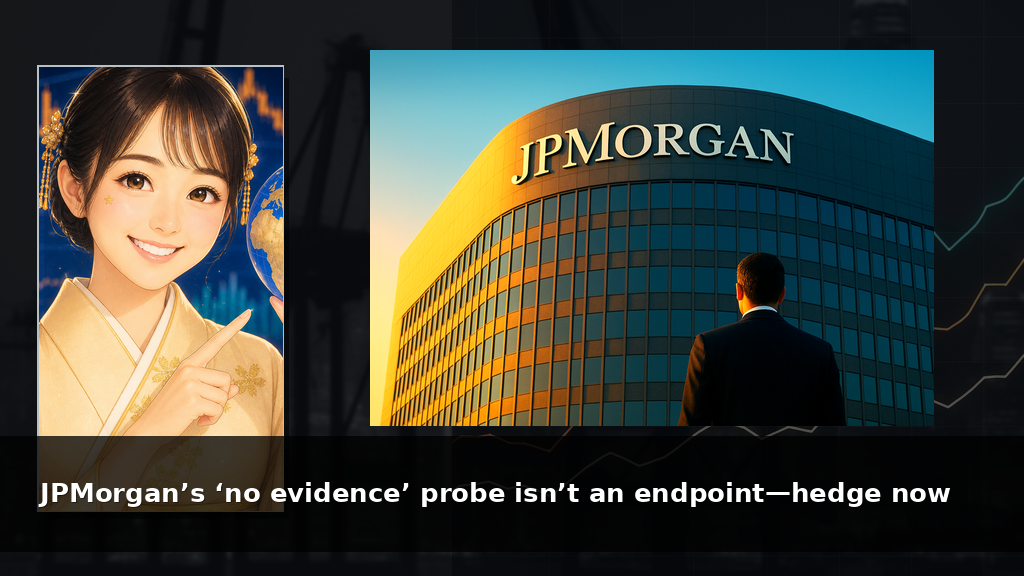
On April 27, 2026, a civil complaint filed in the New York County (Manhattan) Supreme Court under “John Doe” alleged months‑long sexual coercion, drugging, and racial harassment by JPMorgan executive Lorna Hajdini. Subsequent reporting identified the plaintiff as former JPMorgan banker Chirayu Rana, 35. JPMorgan and Hajdini denied the claims, and the bank said an internal review by HR and in‑house counsel found “no evidence.” The filing was later withdrawn for corrections and reappeared on the Manhattan docket around May 4 with additional witness statements reported by multiple outlets. (ndtv.com)
Theme: whether large employers’ internal investigations reliably surface facts or yield institutionally biased outcomes that leave material issues unresolved. This matters to investors and compliance leaders because market and regulatory responses hinge on whether internal findings withstand courtroom discovery and public scrutiny.
Stance: For large‑cap financials equity portfolio managers (PMs) with JPM exposure, hedge governance headline risk; treat the bank’s internal “no evidence” finding as provisional until an index‑numbered amended complaint moves into discovery or a regulator publicly declines to inquire.
Policy & Legal Structure
The pushback we expect: big‑bank internal probes are rigorous and privileged; unless a regulator opens an inquiry, markets should take the bank at its word. That view overstates how much a house‑led review can close the book once litigation commences.
Here, two levers sit outside JPMorgan’s control. First, venue. In Manhattan Supreme Court, the amended/returned complaint (reported May 4) will, once fully docketed with an index number and service, tee up discovery fights that can put internal‑investigation materials before a judge. If the review was directed by in‑house counsel, the bank will assert attorney‑client and work‑product protections. But those shields can narrow when an employer relies on an internal investigation to defend itself: courts examine purpose and may order in‑camera review or production, including in Faragher–Ellerth contexts. The structural point: the court controls whether a closed HR/law‑department file stays closed. (documents.nycbar.org)
Second, parallel oversight. The U.S. Equal Employment Opportunity Commission (EEOC), the New York Attorney General (NYAG), or the New York State Department of Financial Services (NYDFS) can open administrative inquiries with subpoena power. Those forums shift the axis from internal assurance to external verification; the initiation of such an inquiry can reset the market’s risk map even before findings. (eeoc.gov)
Two dynamics heighten the odds that the dispute migrates from controlled internal process to public record. The withdrawal/refiling pattern suggests iterative supplementation by the plaintiff, often a precursor to targeted discovery requests (e.g., communications metadata, bonus‑decision records). And rapid de‑identification by tabloids/mainstream press has already shifted this from an HR matter to a reputational event. Once in that domain, investor‑relations calculus favors disclosure clarity over bare assurances. (m.economictimes.com)
Against that structure, treating the internal probe as dispositive is a weak bet. The mechanism that matters is not HR policy but the jurisdictional gate (Manhattan Supreme Court) and the evidence‑law chokepoint (privilege and its waivers) through which internal files can be tested. Until those gates are cleared—by an index‑numbered docket that advances into motion practice, or by a regulator affirmatively passing—the correct posture for outside capital is hedge, not assume closure.
Nine Star Ki Reading
We read JPMorgan’s HR and in‑house counsel as an authority figure—the decision‑making role that controls findings and privilege. Through that lens, the configuration aligns with Six White Metal (Roppaku Kinsei, 六白金星), matched to the “社長” archetype: command, rank, and public‑facing leadership.
The underlying nature here is hierarchical and duty‑bound—authority expressed through process and institutional standing. What is showing now is the same leadership acting from Northwest (Kenkyū, 乾宮): busy, directive, and intent on control and defense rather than accommodation. Because the backbone and the surface are aligned, the current stance is not a bluff; the organization will keep asserting the internal review as definitive. But the next step in the cycle moves toward West (Dakyū, 兌宮), where speech, exchange, and reputation dominate. Translation: a posture optimized for control will be stress‑tested in communicative arenas—court filings, media narratives, and any regulatory notices—where what is said and shown matters more than what is held internally.
For an external observer, this supports hedging now: expect the center of gravity to shift from internal command to public contestation, and price the communications risk accordingly.
Recommendations
If you are a large‑cap financials equity PM with JPM exposure, hedge governance/reputational risk until a court or regulator provides an external anchor. Maintain exposure discipline: don’t ascribe de‑risking credit to JPM’s “no evidence” statement alone, and be ready to adjust if discovery remains stalled through summer. If you run corporate‑governance screens across the sector, apply a modest penalty to issuers relying on opaque internal probes without independent review.
- JPM 5Y senior CDS (five‑year credit default swaps) vs money‑center peer basket (Bank of America/BAC, Citigroup/C): widen >10 bps relative over 20 trading days; horizon: 1 month.
- JPM 1M ATM (at‑the‑money) equity implied volatility vs 1Y median: +3 vol points or more; horizon: 2 weeks.
- Manhattan Supreme Court docket: motions to compel internal‑investigation materials filed ≥1; horizon: by 3 months.
- Regulator signals (EEOC/NYAG/NYDFS): public inquiry notices ≥1; horizon: by 6 months.
- SEC (U.S. Securities and Exchange Commission) disclosures: Form 8‑K (current report) or equivalent referencing this matter ≥1; horizon: within 12 weeks.
Caveats and Open Questions
- If JPMorgan publishes a detailed, credible report (with contemporaneous emails/metadata and interview logs) or waives privilege to allow independent review—and no regulator opens an inquiry—the market will credit the internal finding and the hedge will look excessive.
- If the amended complaint fails to obtain an index number, stalls without service, or is dismissed on the pleadings, headline risk collapses and the governance discount should be pared back.
- If mainstream, non‑tabloid outlets produce documentary corroboration of a substantial pre‑filing settlement offer and parallel forensic evidence for the drugging claim, the risk shifts from governance‑noise to substantive liability—your hedge becomes an under‑hedge and position sizing must change.
Lead‑time question: Within 12 weeks, does the Manhattan docket show at least one motion to compel the bank’s investigation files—or are we still trading on press statements alone? The answer determines whether your hedge was prudent or excessive.