Reading the Virginia FBI Raid: Default to Routine, Hedge Optics

Source: https://x.com/i/status/2052043153352352057
Observation
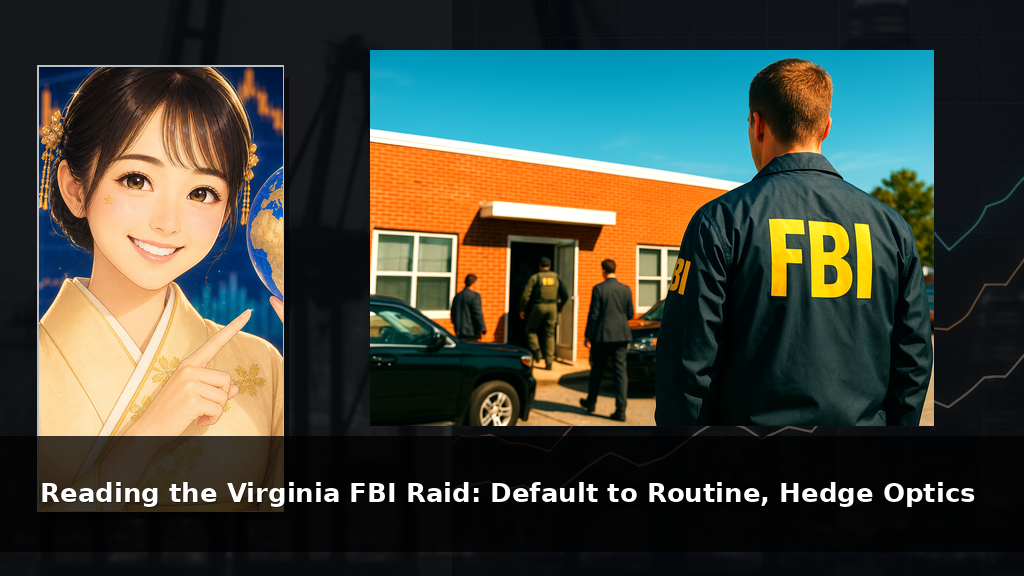
On May 6, 2026, FBI agents executed multiple search warrants at the Portsmouth office of Virginia Senate President Pro Tempore L. Louise Lucas; agents also searched a nearby cannabis dispensary, according to Fox 5 DC. The warrants were approved by a federal judge, and no charges were disclosed as of publication. Local outlets echoed the on‑scene reporting; official agencies have not identified a lead prosecuting office or filed public charging documents.
The live question is whether this is a routine, evidence‑driven public‑corruption probe or politically selective enforcement against a high‑profile state official. It matters because the answer sets the baseline for policy risk, investor and reputational exposure in Virginia, and the timing and temperature of any legislative disruption.
Our call: hedge. If you are a corporate government‑affairs or investor relations (IR) lead with material Virginia exposure, operate on a routine‑investigation baseline unless Eastern District of Virginia (EDVA) filings or a Department of Justice Office of Inspector General (DOJ OIG) action point the other way. Keep messaging neutral and stand up a docket watch for eight weeks before re‑pricing legislative risk.
Policy & Legal Structure
The pushback we hear first is simple: a raid on a state legislative leader is inherently political. That claim only holds if the legal machinery deviates from standard channels. So far, the observable instruments are standard: judge‑authorized federal search warrants, executed by a local FBI field office, with no public charging yet. That puts the next decisive move with prosecutors and the court, not with commentators.
Mechanically, here is what matters. The FBI’s Norfolk Division (which covers Portsmouth) executed the searches, which presupposes probable‑cause affidavits sworn by an agent and approved by a federal judge. Those affidavits, the seized materials, and any recordings now sit with the U.S. Attorney’s Office for the Eastern District of Virginia (USAO‑EDVA). USAO‑EDVA is the venue that will either (a) file a criminal complaint, (b) seek an indictment through a grand jury, or (c) do neither while continuing covert investigation.
Each path produces a different public trail: docket entries in Public Access to Court Electronic Records (PACER) and a USAO‑EDVA press release if charges are filed; motions to seal or unseal if grand‑jury timing requires it. These are routine gates.
State actors will shape the optics but not the elements. Governor Abigail Spanberger and Attorney General Jay Jones can demand transparency or voice support; Portsmouth officials may signal cooperation or skepticism. Those statements can raise pressure on prosecutors, but they do not substitute for filings. The only structural triggers that credibly flip this into a “selective enforcement” frame are oversight‑grade anomalies — for example, a formal DOJ OIG inquiry into political interference, or documentary proof of irregular direction of EDVA by political staff. Absent those, the decisive points remain the court venue (EDVA), the prosecutor’s charging decision (USAO‑EDVA), and the public docket.
The dispensary search could point to a business‑finance nexus (bribes, kickbacks, honest‑services fraud) — or it could be parallel activity in the same building. The mechanism to resolve that ambiguity is again procedural: ownership and transaction records in Virginia State Corporation Commission (SCC) filings and, if charges come, the statutes listed in the complaint or indictment. Until then, treat media narrative as noise and filings as the signal.
Nine Star Ki Reading
Read the operational actor — the FBI’s Norfolk field office as an action in motion — through Six White Metal (Roppaku Kinsei, 六白金星). The tenor here is 訓練: trained, disciplined execution under authority. That fits a field unit working warrant plans rather than staging a show.
In the background, the posture is hierarchical and procedural — authority exercised through rank and rules. What is showing now is steadier and quieter: at 坤宮, the work is patient collection, cataloging, and preservation of records more than visible confrontation. The two are aligned: the surface shows the same discipline the structure is built on, suggesting the move is not a bluff. In cycle terms, sitting at 坤宮 moves next toward 離宮 — a turn from careful consolidation to visibility and exposure. Translated to this case, that implies a shift from evidence capture to public‑facing steps: a complaint, an indictment, or at least a prosecutorial explanation. It reinforces the point above: filings, not rhetoric, will carry the weight.
Recommendations
If you are a corporate government‑affairs lead, IR head, or policy risk owner with Virginia exposure, anchor plans to a routine‑probe baseline and hedge optics. Keep public messaging process‑neutral, prepare questions and answers (Q&A) that reference filings rather than media claims, and build a light‑touch monitoring cell around EDVA and USAO‑EDVA. Defer any escalation of legislative‑risk assumptions until you see a charging instrument or an oversight‑grade anomaly.
- Eastern District of Virginia docket (via PACER): threshold ≥1 criminal complaint/indictment or an “In re: Search Warrant” entry naming Lucas within 14 days; reassess if none by day 56.
- USAO‑EDVA press releases: threshold ≥1 release naming statutes (e.g., bribery, honest‑services fraud) within 8 weeks; if none by week 10, reevaluate timeline and narrative risk.
- Virginia Office of the Attorney General (OAG)/Governor actions: threshold ≥1 formal letter/request to DOJ or call for independent review within 14 days; if issued, raise reputational hedges immediately.
- DOJ OIG announcements: threshold ≥1 inquiry related to this matter within 60 days; if triggered, pivot to selective‑enforcement contingency planning.
- Virginia SCC/land records: threshold ≥1 public record linking Lucas or controlled entities to the dispensary within 30 days; if present, model a business‑nexus charge set.
Caveats and Open Questions
Three conditions would force us to walk back the routine‑probe baseline. First, if DOJ OIG opens a formal inquiry into political interference in this investigation, the selective‑enforcement frame becomes credible and requires repositioning. Second, if the Governor or Attorney General formally demands affidavits or an independent review — and the Department resists without timely filings — the legitimacy cost rises and warrants a more defensive stance. Third, if twelve weeks pass with no EDVA complaint or indictment while credible reporting surfaces of unusual investigative acceleration or political direction, the politicization thesis merits greater weight in risk planning.
Lead‑time question: will an EDVA charging document or motion to unseal land within 2–8 weeks — confirming a routine path — or will the absence of filings plus an oversight trigger force you to reposition for a selective‑enforcement narrative?