Hormuz Shock Spikes Fuel and Flights; Resist Export Bans

Source: https://x.com/i/status/2052151529046417467
Observation
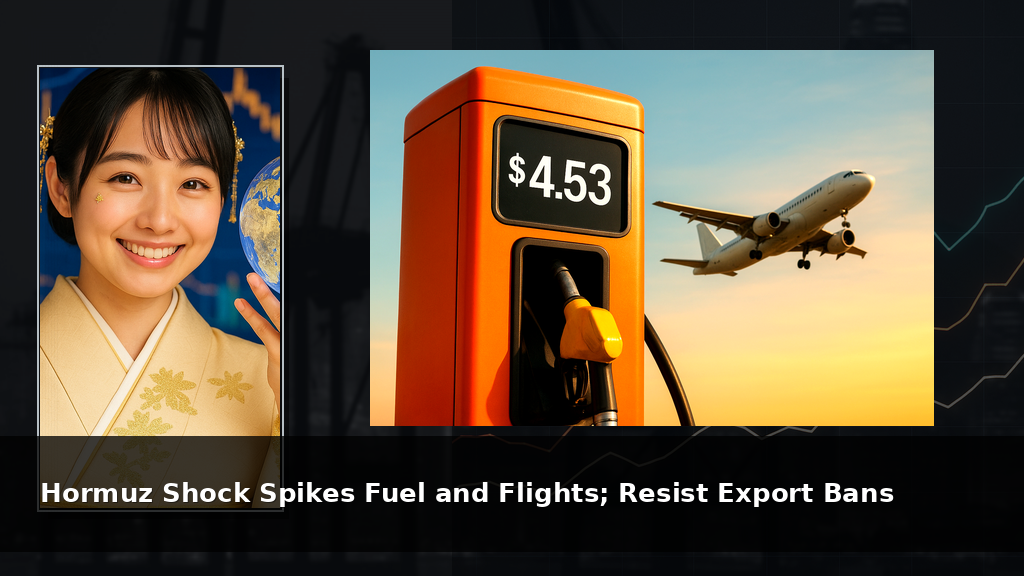
AAA reports the U.S. national average for regular gasoline at $4.536 per gallon as of May 6, 2026. (gasprices.aaa.com) In parallel, outlets citing Cirium say airlines removed about 13,000 flights—nearly two million seats—from May schedules amid surging jet‑fuel costs tied to disrupted Middle East oil flows, including through the Strait of Hormuz. (theguardian.com) The rounding in headlines varies ($4.53–$4.54), but the primary source for pump prices is AAA; the flight‑cut snapshot comes from Cirium summaries reported on May 5–6. (cbsnews.com)
The live question is whether governments should impose refined‑fuel export restrictions to blunt domestic pump‑price pain from a Hormuz‑driven crude/jet‑fuel shock. It matters for investors, policy teams and travel managers because the policy is politically tempting, fast to announce, and market‑moving—but it may backfire by fragmenting product markets and worsening scarcity already forcing 13,000 flight cuts. (theguardian.com)
Our stance: for U.S. equity PMs with airline and refining exposure, avoid the “export‑ban relief” trade and hedge for persistently wide product spreads. Price in relief only if you see physical supply added (OPEC+ decisions, ADNOC routing) or stock releases (U.S. Department of Energy/International Energy Agency), not if you see trade walls go up.
Geoeconomic Structure
The pushback we hear most is simple: if you keep more gasoline and diesel at home, domestic prices should fall. The problem is the binding constraint is physical flow—crude and product routing around a partially constrained Strait of Hormuz and a refinery system running into yield limits—not the legal right to export.
Start with the bottleneck. The Strait of Hormuz ordinarily carries a large share of global crude and product flows. With that corridor impaired, Gulf exports have been diverted onto longer, costlier routes; some volumes are delayed outright. That tightens feedstock for refineries and raises product crack spreads. U.S. retail prices are set off a globally integrated product market; when the marginal barrel is scarce abroad, the domestic pump price follows the global signal.
Next, look at what refineries can actually do. Jet fuel and other middle distillates have led the tightness; the reported airline cuts—13,000 flights and almost two million seats—are the demand‑side confirmation that jet is dear. (theguardian.com) Refinery configurations cannot painlessly switch to produce much more jet or gasoline on short notice; conversion units, maintenance schedules and environmental specs cap flexibility. An export ban does not create distillate or gasoline‑blending capacity. It risks lowering refinery runs on the U.S. Gulf Coast by stranding barrels sized for export markets, ultimately reducing domestic availability of the grades consumers need.
Now consider who has leverage. Producers and hubs with alternative corridors—ADNOC routing Murban and products via Fujairah, Saudi east‑west pipelines, Iraq‑Turkey lines—are the actors who can add real supply fast. If ADNOC/Fujairah leans in, some lost Hormuz capacity is offset, but those flows still clear at world prices. A unilateral U.S. refined‑product export curb would not unlock more feedstock; it would rewire cargoes, widen regional spreads (U.S. Gulf Coast vs Amsterdam–Rotterdam–Antwerp vs Asia) and invite reciprocal measures or diplomatic costs with partners who rely on U.S. barrels.
What can work in the near term are instruments that add molecules, not paperwork: OPEC+ (Organization of the Petroleum Exporting Countries and partners) decisions that deploy spare capacity and observable increases in seaborne exports; coordinated DOE/IEA (U.S. Department of Energy/International Energy Agency) releases of crude or products that lift EIA‑reported stocks. Those are the series that move gasoline RBOB (RB) and NY Harbor ULSD (HO) futures on CME Group—and, through them, AAA’s daily gauge. (eia.gov) By contrast, export bans tend to show up as fragmented pricing—wider regional price differentials and shipping reroutes visible in automatic identification system (AIS) ship‑tracking—rather than broad, sustained pump relief.
Finally, the airline response is a transmission channel, not a cause. Cirium’s cut count tells you fuel scarcity is binding on operations. When large, concentrated jet buyers shrink capacity at this scale, it confirms the price signal is biting. If policy worsens the global product shortage by walling off U.S. barrels, airlines and freight will feel it first—in higher surcharges and thinner networks—even if a temporary headline lift shows up at a few domestic pumps. (theguardian.com)
In value‑chain terms: the chokepoint (Hormuz) constrains the upstream flow; the gatekeepers (OPEC+/Saudi, ADNOC) and the stock‑release venue (DOE/IEA) are the only rapid levers; the refining system is the bottlenecked node; airlines are the demand‑side amplifier; AAA is the domestic price signal to watch. Export restrictions are aimed at the wrong node.
Nine Star Ki Reading
Read as a place—an export hub and logistics venue—ADNOC/Fujairah sits at the center of this story. Applying 九星気学 to that place gives us Eight White Earth (Happaku Dosei, 八白土星) with the concrete image of a warehouse (倉庫): stock held in reserve, controlled gates, the ability to marshal and redirect flows.
The background here is a hub built to manage physical stock and territorial logistics—warehouses, tanks, berths and the operational muscle to pivot shipments quickly. What is showing now is the same nature made visible: acting as a ground‑level consolidator, a packing and rerouting point that substitutes for Hormuz as best it can. The background and the current state are aligned; this is not a bluff. The warehouse is both full and active.
In cycle terms, the hub sits at Southwest (Konkyū, 坤宮) at the moment—quiet consolidation, stockpiling, control on the ground. The next move is toward South (Rikyū, 離宮), where things become more exposed and heated: the hub’s role will be more visible in price formation, and attention—and pressure—will intensify. For the observer, expect ADNOC/Fujairah to matter more in the tape, not less; as it moves from consolidation to market‑facing prominence, regional spreads are likely to stay wide.
This lens reinforces the supplier‑leverage argument above. Relief for U.S. motorists comes from engaging the warehouses and corridors that can release marginal barrels, not from closing off exports at home. As the hub’s visibility rises, the price you pay will reflect its operating choices and available feedstock, not your legislature’s appetite for trade walls.
Recommendations
If you are a U.S. equity PM with airline, refining and travel exposure, do not price in sustained pump relief from refined‑product export bans. Hedge for persistent product tightness and elevated crack spreads, and let your exposure turn only when you see physical supply additions or stock releases reflected in the data below. If you are a corporate travel manager, plan for higher fares and thinner networks through early summer unless these same indicators break your way.
- AAA Daily National Average (regular gasoline): If a U.S. export restriction or SPR action is announced, require a ≥$0.10/gal decline within 14 days to treat it as genuine relief; otherwise fade the move (daily, next 2 weeks). (gasprices.aaa.com)
- EIA Weekly Gasoline/Distillate Stocks and SPR: Look for a ≥10 million barrel WoW rise in gasoline stocks or an additional coordinated release >20 million barrels to validate supply relief (weekly, next 1–6 weeks). (eia.gov)
- CME RBOB (RB) and NY Harbor ULSD (HO) front months: Treat sustained >15% declines from the recent peak as confirmation of easing product scarcity (daily to weekly, next 1–4 weeks). (cmegroup.com)
- Observed seaborne exports (Saudi/ADNOC via ship‑tracking): A ≥0.5 mb/d increase sustained for two consecutive weeks is your green light that physical flow is improving (weekly, next 2–6 weeks).
- Cirium schedule data: Watch for net re‑additions of ≥2,000 flights in May/June or, conversely, an acceleration of cuts by ≥5,000 flights; either is a live read on jet availability (fortnightly, next 2–4 weeks). (theguardian.com)
Caveats and Open Questions
- If the U.S. executive actually imposes a refined‑product export restriction and AAA’s national average falls by ≥$0.10/gal within 14 days—accompanied by >15% declines in RBOB/ULSD—then the case against export bans weakens and we would revisit this stance. (gasprices.aaa.com)
- If OPEC+/Saudi and ADNOC deliver observable additional seaborne exports of ≥0.5 mb/d within 2–6 weeks, easing crack spreads and pulling futures lower without domestic trade measures, our call shifts from “hedge for persistence” to “normalize exposure” sooner.
- If a U.S. export curb triggers no meaningful market fragmentation—e.g., U.S. Gulf Coast–ARA product spreads fail to widen and partners lodge no trade objections—while domestic prices still fall, the expected distortion cost is overstated and the stance needs revising.
Lead‑time question: which first‑mover unlocks relief you can trust within the next four weeks—the White House announcing an export action, OPEC+/ADNOC adding ≥0.5 mb/d of exports, or DOE/IEA confirming a >20 mb stock release?