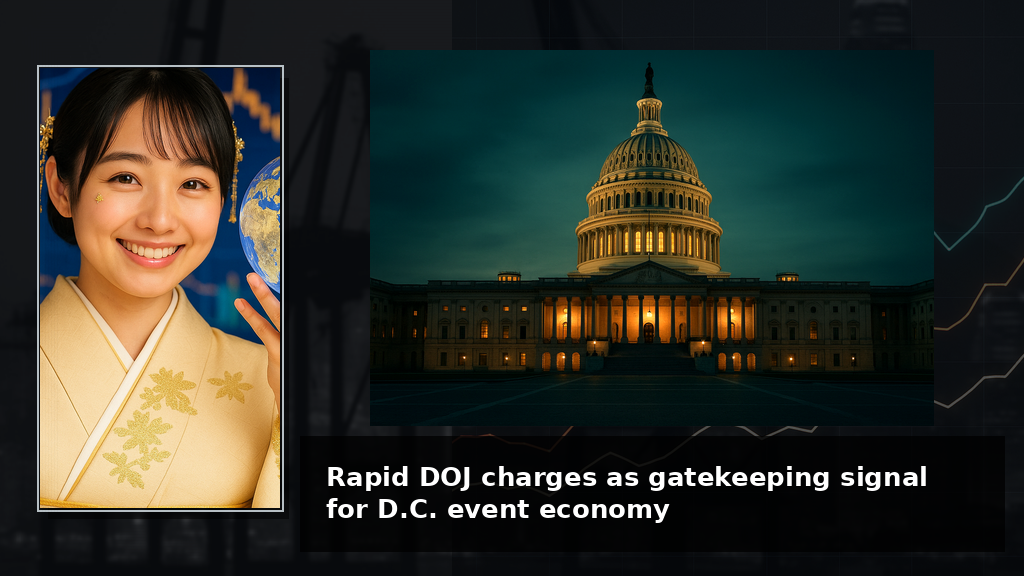
Rapid DOJ charges as gatekeeping signal for D.C. event economy

元ツイート: https://x.com/i/status/2049230062084334045
Observation
On April 25, 2026, Cole Tomas Allen allegedly rushed a magnetometer checkpoint at the Washington Hilton during the White House Correspondents’ Association dinner; shots were fired and a Secret Service officer was struck in the chest while wearing a ballistic vest. Two days later (April 27), federal prosecutors charged Allen with attempted assassination of the President, interstate transportation of a firearm with intent to commit a felony, and discharge of a firearm during a crime of violence, and held a DOJ press conference with Acting AG Todd Blanche, FBI Director Kash Patel, and U.S. Attorney Jeanine Pirro. DOJ’s primary release documented hotel reservation and travel records, matched serial numbers for a 12‑gauge shotgun (purchased Aug. 17, 2025) and a .38 pistol (Oct. 6, 2023), and noted ballistics/device analyses remain ongoing; reporting cited ~3,000 attendees in the ballroom.
This commentary focuses on whether the rapid filing of charges is purely evidence-driven or also an institutional signal that reshapes incentives in the events/hospitality network. The angle matters because prosecutorial timing functions as a policy instrument that affects venue operations, insurance pricing, security procurement, and congressional oversight; stakeholders from hotel operators to reinsurers must position under uncertainty about attribution and follow-on rules.
Geoeconomic Structure
Structural thesis: prosecutorial timing operates as a gatekeeping signal inside a tightly coupled event-security–economic network. By charging within 48 hours and controlling public messaging, DOJ/FBI aim to truncate uncertainty and stabilize exposed actors (venues, insurers, organizers), even as unresolved forensics preserve information asymmetries that others must price.
Geographically, the chokepoint is the Washington Hilton terrace-level checkpoint where the breach occurred; the ballroom’s concentration of principals (≈3,000 attendees) embodies single-site exposure. The corridor dimension includes the long-distance rail route cited in the complaint, relevant to interstate-transport charges. The agglomeration at issue is the downtown D.C. hotel/event cluster whose economics depend on large, security-intensive gatherings.
At the network/GVC layer, prosecutors (DOJ/U.S. Attorney) and the FBI Washington Field Office are gatekeepers: they control timing, evidence releases, and narrative framing. The Secret Service is the protective node whose tactical outcome (officer struck; return fire) is central to confidence but depends on prosecutorial attribution for legitimacy. Venues, organizers (WHCA), and event insurers internalize the economic transmission of risk. Dependencies run from DOJ’s charging posture to FBI forensics; from venue bookings to insurer underwriting; and from public perception to DOJ/FBI communications. Asymmetries are pronounced: DOJ/FBI possess privileged forensic visibility (e.g., ballistics) while venues/insurers must act before those disclosures land.
Policy instruments now in play include rapid federal prosecution and coordinated press briefings (signaling control), potential tightening of event-access rules by the Secret Service, insurance repricing for D.C. high-profile events, and congressional oversight/appropriations. The dominant dynamic is deterrence-by-signal: a fast complaint and visible federal posture to contain contagion risk to the event economy—while inadvertently accelerating debates over venue centralization and security cost transfers.
Nine Star Ki Reading
We read the day/month/year configuration as Four Green Wood (day), Six White Metal (month), One White Water (year). As a structural lens, it surfaces frictions and catalysts that the geoeconomic frame alone does not.
- Day (Wood) → Earth is controlling (木剋土): immediate narrative movement stresses earth-type sectors—venues and insurers—suggesting the timing itself can pressure foundational actors rather than purely stabilize them. This diverges from the gatekeeper-stabilization thesis by flagging near-term booking/underwriting strain despite DOJ’s intent to steady the network.
- Month (Metal) → Wood is controlling (金剋木): authoritative standards and oversight prune diffuse communications, implying a quick shift from narrative volatility to formalized procedures and procurement rules. Expect pruning of speculation into codified directives.
- Year (Water) → Wood is productive (水生木): information/liquidity catalyzes communications and data-centric processes, turning forensics/disclosure into a seed for structural change (e.g., evidence-sharing protocols, new underwriting products), not just a vulnerability to be closed.
Sector alignments most relevant now: - Real Estate (venues) — caution: Day Wood → Earth (木剋土) signals pressure on bookings and perceived safety premiums; even stabilizing intent can transmit as near-term stress to large single-site assets. - Financials (insurers) — caution: the same Wood → Earth control relation frames insurer behavior as narrative-driven in the immediate window, reinforcing Phase 2’s expectation of repricing but as a triggered pressure rather than orderly recalibration. - Industrials (security contractors) — favorable: Month Metal resonance supports standard-setting and disciplined procurement, a tailwind for capable suppliers able to meet tightened specifications.
Recommendations
- Watch DOJ/FBI evidentiary milestones: ballistics or detailed filings on PACER/DOJ OPA that attribute the officer’s wound within 2–6 weeks; confirmation would validate evidence-driven timing and dampen overreaction (Phase 2 indicator).
- Monitor Secret Service/White House guidance on off-site events; a directive limiting commercial ballrooms within 1–3 months would signal centralization and cost shifts (Phase 2 indicator).
- Track insurance market signals: Lloyd’s market bulletins or major event underwriters/reinsurers announcing D.C. premium adjustments or exclusions within 1–2 months (Phase 2 indicator).
- Real Estate (venue operators/investors): consider hedging exposure to large single-site political events, diversify to smaller or government-partnered venues, and renegotiate force-majeure/security-cost pass-throughs (Phase 3 recommendation).
- Financials (insurers/brokers): watch underwriting bulletins and riders tied to political violence/event-cancellation; prepare triage for D.C.-exposed portfolios and recalibrate aggregates (Phase 3 recommendation).
- Industrials (security): consider selective exposure to firms positioned for standards-driven demand; screen for capacity to meet rapid compliance cycles (Phase 3 recommendation).
- Information Technology/forensics: consider partnerships in validated forensic tooling and secure evidence-sharing that can shorten attribution timelines and convert uncertainty into priced risk (Phase 3 recommendation).
- Venue-level ops: track cancellation rates and booking shifts for major D.C. ballrooms over the next 3 months via trade associations; early movement will reveal how the timing signal transmits to demand (Phase 2 indicator).
Caveats and Open Questions
Key facts remain unresolved: which round struck the Secret Service officer, whether Allen had organizational ties, and whether additional charges will be added as device/forensic work completes. Source conflicts persist on the number and sequence of shots and attribution. Causality is hard to isolate—market behavior may respond to the incident itself more than to prosecutorial timing. Internal DOJ deliberations are not observable; intent is inferred from public actions. Data gaps include insurer underwriting decisions, private booking pipelines, and classified Secret Service guidance—constraining precision on near-term economic effects.
Which indicator will you track first: a DOJ PACER filing that attributes the ballistic hit, a Secret Service directive on off-site events, or a Lloyd’s market bulletin on D.C. event premiums?