King Charles’ U.S. visit: can ceremony unlock Iran coordination?

元ツイート: https://x.com/i/status/2049148815031009650
Observation
King Charles III and Queen Camilla began a four-day U.S. state visit on April 27–30, 2026, arriving at Joint Base Andrews and joining President Donald J. Trump and First Lady Melania Trump for White House events. The official program included a South Lawn State Arrival Ceremony with the U.S. Army Herald Trumpets, national anthems by the U.S. Marine Band, a 21-gun salute, and troop review (White House schedule, April 25, 2026). The King was slated to address a joint meeting of Congress, the first comparable speech by a British monarch since 1991 (AP, April 1, 2026). Security arrangements were reviewed after an April 25 incident linked to the White House Correspondents’ Dinner.
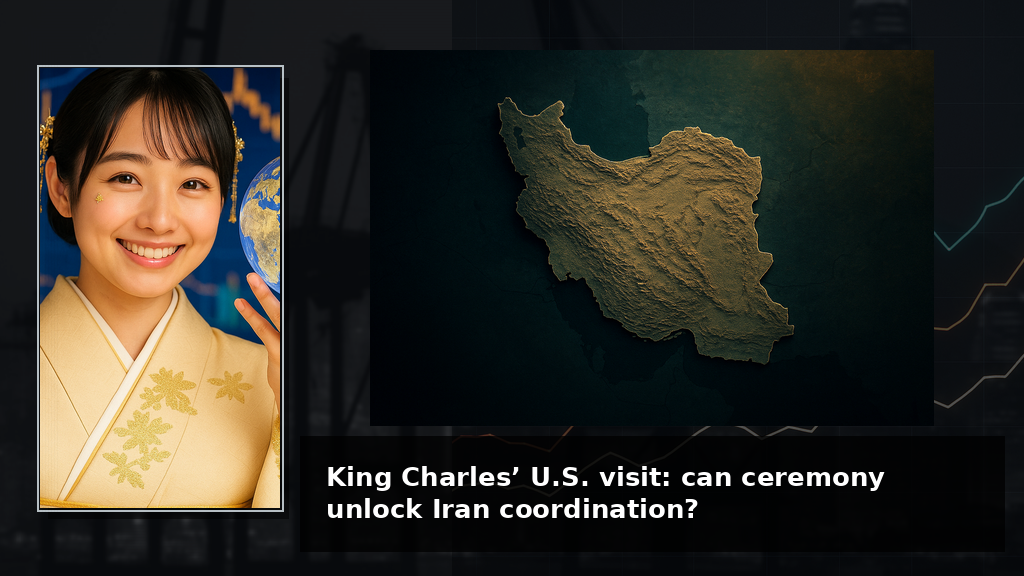
This analysis focuses on whether personalization and ceremonial diplomacy during the visit can translate into targeted, durable improvements in U.S.–U.K. coordination on Iran-related security issues, or remain largely symbolic. The question is debatable because leader-level rapport can lower frictions, but key levers—sanctions, funding, operational authorizations—sit with institutions like Congress and defense/intel leadership. Policymakers and investors in defense, communications, and energy care because any shift in coordination affects information-sharing reliability, sanctions calibration, and deterrence signaling.
Geoeconomic Structure
The dominant geoeconomic dynamic is that ceremonial, leader‑level diplomacy functions as a low‑cost mechanism to reduce coordination frictions across high‑betweenness institutional nodes (executive offices, intelligence/defense agencies, and legislative bodies), enabling targeted confidence‑building measures but not substituting for the material and institutional levers that determine substantive policy.
Geographically, the visit concentrates signal at chokepoints—the White House/South Lawn and Joint Base Andrews—while reopening the Washington–London corridor for high-visibility engagement. The congressional chamber becomes an institutional corridor where the UK can shape legislative perceptions directly via the King’s address. Washington, D.C.’s agglomeration effect (executive, legislative, diplomatic missions) increases the probability that soft signals propagate into working-level channels.
On the network layer, the U.S. Executive and the UK Royal Household are high-attention nodes that can strengthen interpersonal edges; however, implementation paths traverse gatekeepers: the U.S. Congress (sanctions, appropriations, oversight) and defense/intelligence leadership (DoD/UK MoD, Five Eyes). Dependencies run both ways—UK access to U.S. operational/intel cooperation relies on institutional trust, while U.S. coalition management benefits from UK alignment. Asymmetries persist: the UK’s primary leverage here is symbolic capital; the U.S. holds material and legislative capacity, yielding network centrality advantages in policy execution.
Policy instruments in play are ceremonial diplomacy (the state arrival), the King’s address to a joint meeting of Congress (legislative signaling), and bilateral executive/ministerial sessions (where discrete confidence-building measures—protocols, exercises—can be codified). The structure suggests a modest-but-real opportunity: rapport can reduce transaction costs for targeted intel/defense steps, while large strategic divergences over Iran policy remain constrained by institutional veto points.
Nine Star Ki Reading
Day 4 Wood sits within Year 1 Water and Month 6 Metal. Structurally, Year Water → Day Wood (水生木) is productive: the annual backdrop nourishes information flow and relationship-building, reframing the “optics risk” as a potential catalyst for constructing information‑sharing architecture. Month Metal → Day Wood (金剋木) is controlling: near‑term discipline and oversight will prune any overgrowth of symbolic momentum, channeling it into standards and protocols rather than spectacle. Day Wood → Earth/Financials (木剋土) is controlling: communication‑driven pushes can unsettle funding/sanctions foundations, implying congressional conditionality. Day Wood → Fire/IT (木生火) is productive, supporting secure‑comms pilots; yet Year Water → Fire (水剋火) controls publicity, favoring low‑exposure, protocolized implementations.
Sector alignments most relevant now:
- Communication Services (favorable): Wood↔Wood resonance plus Water → Wood suggests amplified but disciplined messaging—use the ceremonial window to shape clear communiqués and transparent scopes for cooperation, rather than vague rhetoric.
- Information Technology (favorable): Wood → Fire supports rapid, tech‑enabled coordination pilots (secure channels, interoperable protocols), while Water → Fire tempers exposure—design for auditability and minimal public fanfare.
- Financials (caution): Wood → Earth signals pressure on appropriations/sanctions pathways; anticipate pruning via oversight and conditionality rather than expecting smooth funding ramps.
This lens diverges from a purely geoeconomic read by treating disciplined oversight as a constructive force that converts ceremony into durable protocols, rather than only a brake on action.
Recommendations
- Consider Communication Services: within 30 days, watch for a joint communique naming a concrete confidence‑building measure (e.g., coordinated maritime patrols or an intel‑sharing protocol). Favor clarity and bounded scope. [Phase 2/3]
- Consider Information Technology: seed low‑exposure pilots (secure comms, interoperability) that can withstand hearings; validate via a DoD–UK MoD or intel‑community MoU within 90 days. [Phase 2/3]
- Consider Industrials: translate signals into standards/exercise schedules announced within 30–60 days—procurement‑adjacent steps that institutionalize cooperation. [Phase 2/3]
- Watch Financials: monitor U.S. congressional hearings or votes within 60–120 days referencing the visit; treat added oversight or conditionality as base case for funding/sanctions changes. [Phase 2]
- Monitor adversary signaling: track official statements or posture changes from Iran/regional actors that acknowledge tighter U.S.–U.K. coordination. [Phase 2]
Caveats and Open Questions
- The circulating clip that President Trump joked his mother “had a crush” on King Charles is not verified in an official or pool transcript at time of writing; optics matter, but they are distinct from policy outcomes. [Phase 1]
- Correlation is not causation: any post‑visit agreements may reflect pre‑existing negotiations or exogenous shocks, not the visit per se. [Phase 2]
- Personalization effects are contingent on choices by Congress and defense/intel leadership, which remain opaque in public sources. [Phase 2]
- The network lens underweights sudden battlefield developments or third‑party coercion that could override ceremonial leverage. [Phase 2]
Which concrete follow-on signal would most validate your positioning: a U.S.–U.K. defense/intel MoU published within 90 days, a joint communique naming “coordinated maritime patrols,” or a House Foreign Affairs Committee hearing referencing the visit?