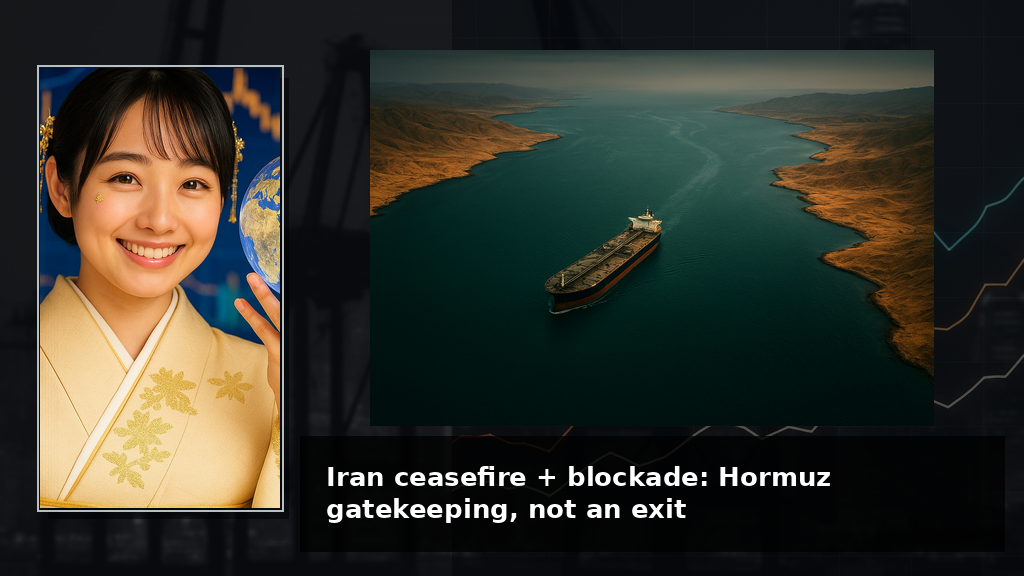
Iran ceasefire + blockade: Hormuz gatekeeping, not an exit

元ツイート: https://x.com/i/status/2049156877204775347
Observation
On Feb. 28, 2026, the United States and Israel launched major strikes on Iran. A Pakistan-mediated two‑week ceasefire was announced Apr. 7–8, conditional on reopening the Strait of Hormuz. On Apr. 21, President Donald J. Trump extended the ceasefire while keeping a U.S. naval blockade of Iranian ports in place, as reported by AP/Reuters. As of Apr. 21, the IMO had confirmed 25 attacks on commercial shipping in the region (AP live). Against this backdrop, Walter Russell Mead argued in the Wall Street Journal (Apr. 27–28) that it is far too early to declare U.S. defeat.
This article focuses on whether Washington’s ceasefire‑plus‑blockade posture is a tactical bargaining stance preserving coercive leverage and escalation options, rather than an expedient political exit. The angle matters because control of Hormuz and insurer behavior set the terms of trade for oil/LNG flows to Asia and Europe; investors, operators, and policymakers have material exposure to how long a coercive equilibrium can be sustained.
Geoeconomic Structure
Thesis: chokepoint gatekeeping as coercive bargaining. By sustaining effective denial of access to Iranian export terminals while offering a conditional ceasefire, the United States converts geographic control into economic leverage that coerces Iran via revenue suppression without requiring continuous kinetic escalation.
Geographic layer: The Strait of Hormuz and Iran’s terminals at Kharg, Lavan, and Sirri are the fulcrum. The ceasefire’s formal linkage to reopening Hormuz, alongside a continued blockade (Apr. 21), channels bargaining power through a single corridor. Escort lanes and de facto insurance‑approved routes function as operational “corridors” whose existence—or withdrawal—translates directly into cost and time for cargoes.
Network/GVC layer: Gatekeepers include the U.S. Navy (physical sea‑denial), P&I clubs and reinsurers (commercial permissioning via coverage and war‑risk pricing), and tanker operators (routing choices). Dependencies are asymmetric: Asian refiners (China, India, Japan, South Korea) depend on reliable Hormuz transit; Iran depends on seaborne exports for hard currency; traders depend on predictable insurance. Asymmetries favor the U.S. on visible sea control, while Iran wields intermittent, lower‑cost disruption (the IMO‑tracked 25 incidents) that raises premiums and complicates verification of “reopening” claims.
Policy instruments in play mirror this architecture: the blockade itself; sanctions and Treasury pressure; selective maritime escorts; and diplomatic mediation via Pakistan to structure timelines and text for any Iranian proposal. The dominant dynamic is a leverage‑preserving pause: the Apr. 21 extension keeps diplomatic oxygen in the room while the blockade and insurance market risk continue to restrict Iranian export realization.
Nine Star Ki Reading
Configuration: day star 四緑木星 (Wood), month star 六白金星 (Metal), year star 一白水星 (Water). The structural lens highlights divergences from the purely geoeconomic read.
- Energy (一白水星/Water) shows favorable alignment: month Metal → Water is productive (金生水), and the year is also Water. This supports precise state operations that enable controlled management of seaborne flows—i.e., the naval/operational layer has near‑term reinforcement.
- Financials (五黄土星/Earth) warrant caution: day Wood → Earth is controlling (木剋土). Where the geoeconomic frame treats insurers/reinsurers as reliable amplifiers of the blockade, this reading flags them as a potential fragility. Growth/flow adaptations—reflagging, information‑led routing, dark‑fleet practices—can erode insurer discipline faster than states adjust policy.
- Industrials (六白金星/Metal) are aligned: month Metal → Metal provides same‑element resonance, emphasizing command, standards, and logistical precision—consistent with short, disciplined enforcement moves.
Overlay: while month Metal also acts to prune Wood (金剋木), implying regulatory tightening can periodically suppress adaptive workarounds, the day Wood pressure on Earth suggests private‑sector gatekeeping may fragment under stress. Net: the physical coercion layer is reinforced; the private‑commercial enforcement layer is the variable to watch.
Recommendations
- Energy — consider: Act tactically on verified physical signals. Monitor AIS/UNCTAD tanker counts through Hormuz and weekly loadings at Kharg/Lavan/Sirri; a sustained absence or resumption confirms or refutes effective interdiction (Phase 2 watch; Phase 3 sector stance).
- Financials — watch: Track P&I club and reinsurer war‑risk notices (e.g., premium adjustments, coverage withdrawals). Day Wood → Earth (木剋土) flags susceptibility to rapid change (Phase 3), and insurer policy is a decisive gate (Phase 2).
- Industrials — consider: Watch U.S. DoD/U.S. Navy posture statements on blockade rules, escort operations, and contractor tasking; month Metal alignment supports short‑run operational tightening (Phase 2 instruments; Phase 3 sector stance).
- Verify tanker departures/arrivals from named Iranian terminals using reputable tanker‑tracking sources; sustained loadings would contradict continued effective blockade (Phase 2 watch).
- Watch for publication or transmission of a written, Pakistan‑mediated “unified proposal” from Iran; documented text would reshape the bargaining set and the need for blockade leverage (Phase 1 unresolved; Phase 2 watch).
- Reduce exposure to Gulf‑concentrated tanker operators if major P&I clubs signal restrictive coverage or sharp premium hikes; private governance can close routes de facto even without new state action (Phase 2 asymmetry; Phase 3 caution on Financials).
Caveats and Open Questions
Key facts remain unsettled. It is unverified whether Iran has formally submitted the “unified proposal” referenced by President Trump, and its content—if it exists—could change the negotiation frontier (Phase 1). Reporting conflicts on whether the Strait of Hormuz was fully reopened under the ceasefire or subsequently re‑closed highlight verification challenges (Al Jazeera versus later AP/regional reports). The technical scope of damage to Iranian nuclear and critical infrastructure from the Feb. 28 strikes is not independently established, limiting assessment of coercive durability. Open‑source maritime data can be spoofed or obscured via ship‑to‑ship transfers and reflagging; triangulation with insurer notices and port calls is necessary (Phase 2). Private‑actor behavior (insurers, shipowners) is path‑dependent and may not track state intent. Finally, domestic U.S. political dynamics could override a clean geoeconomic logic of sustained blockade.
Which indicator will you anchor on this week — AIS‑verified loadings at Kharg, UK P&I Club war‑risk notices, or a DoD/Navy statement on blockade posture?