Project Freedom: Price an information‑led Hormuz reopening

Source: https://x.com/i/status/2051093253840158880
Observation
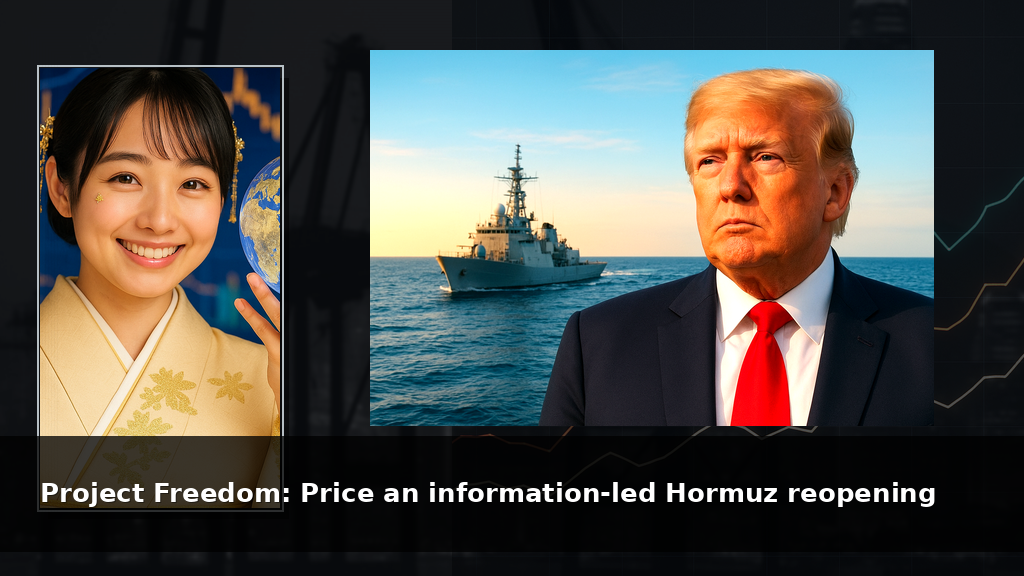
On May 3, 2026, President Donald Trump announced “Project Freedom” to help neutral commercial vessels exit the Strait of Hormuz; U.S. Central Command (CENTCOM) said forces would begin supporting the effort on May 4 (per CENTCOM’s May 3 press release). CENTCOM listed guided‑missile destroyers, over 100 land‑ and sea‑based aircraft, unmanned platforms, and 15,000 service members, noting the strait carries a quarter of the world’s seaborne oil. Contemporary reports counted hundreds of vessels and roughly 20,000 seafarers stranded in the region (Associated Press), while Axios, citing two American officials, reported the initiative “will not necessarily include U.S. Navy ships escorting commercial ships.”
The live question is whether Project Freedom stays an information‑sharing/presence construct or becomes de facto ship‑to‑ship escorts that change insurers’ and owners’ behavior. This is worth your time because the operational form, not the press line, will set escalation risk and determine whether insurance gates reopen and oil flows resume—moving prices, spreads, and supply‑chain decisions in days, not quarters.
Our call for macro and energy portfolio managers: Position for an information‑led, partial reopening over the next 2–4 weeks rather than a blanket escort regime; fade the “hard‑escort” premium but keep tail hedges for an Iran‑U.S. incident.
Geoeconomic Structure
A skeptic’s first pushback is fair: mere presence without escorts won’t change underwriting. But in this theater the commercial chokepoint sits above the geography—at the insurance desk. The International Group of Protection and Indemnity (P&I) Clubs and their London market reinsurers effectively control war‑risk cover. If they judge that documented risk has fallen, Notices of Cancellation can be modified or rescinded quickly; owners then have both cover and a board‑defensible rationale to sail.
CENTCOM can influence that calculus without ordering close‑in escorts. The command is fielding destroyers, multi‑domain intelligence, surveillance and reconnaissance (ISR), and 100+ aircraft. If that posture is translated into insurer‑grade evidence—timely incident suppression, transparent rules‑of‑engagement (ROE)‑compliant interactions, and verifiable “ship in vicinity” responses captured by UK Maritime Trade Operations (UKMTO) advisories and Automatic Identification System (AIS) ship‑tracking data—underwriters have what they need to ease terms. That is the mechanism: authoritative presence generates auditable information, which reopens the commercial gatekeeper. Only after the information channel fails does ship‑to‑ship pairing become necessary.
On the demand side, owners and charterers respond to two prices: physical risk and insurability. Published War Risk Surcharges (WRS) and route advisories from carriers (e.g., Hapag‑Lloyd’s March war‑risk measures) are adjusted in days when insurers shift stance. Expect a two‑tier reopening—tonnage with cover and acceptable WRS resumes, while others continue to avoid—until insurers move in concert. That still restores meaningful flow and compresses the fear premium.
Two buffers argue that a presence‑first approach can stabilize markets without hard escorts. First, bypass infrastructure is already absorbing some flows: reporting places Saudi Aramco’s East‑West (Petroline) throughput near expanded capacity around 7 million barrels per day (mb/d), and the UAE’s Habshan–Fujairah Abu Dhabi Crude Oil Pipeline (ADCOP) at roughly 1.5 mb/d. These corridors reduce the immediate volume Project Freedom must enable to ease prices. Second, the adversary’s coercive toolkit—Iran’s Islamic Revolutionary Guard Corps (IRGC) small‑boat harassment—has been most effective against unprotected or isolated transits. A visible U.S. response posture “in the vicinity,” logged in real time by UKMTO, raises the cost of such tactics without crossing into sustained escorts that heighten escalation risk.
Label the mechanics: the Strait of Hormuz is the geographic chokepoint; insurers are the commercial gatekeeper; UKMTO is the situational‑awareness node; CENTCOM is the deterrent/ISR provider. The transmission channel to markets runs presence → incident suppression/data → insurance reinstatement/WRS reduction → AIS‑observable transits. That is why we price an information‑led partial reopening as the base case.
Nine Star Ki Reading
Six White Metal (Roppaku Kinsei, 六白金星) is the star of authority and precision; here, it corresponds to CENTCOM and the U.S. Navy, because their disciplined command and ISR posture are the authoritative instruments on scene. One White Water (Ippaku Suisei, 一白水星) is the star of flow and networks; here, it corresponds to the insurance and information network around UKMTO and the P&I market, because these actors translate risk signals into cover terms and routing decisions.
Six White Metal → One White Water, Metal produces Water (kin‑sho‑sui, 金生水), a productive relation. Read literally for this case: precise, well‑documented operations can feed and expand credible information flows, which underwriters and owners use to change behavior. The implication for positioning is concrete: the quickest path to normalized traffic does not run through hard escorts, but through turning CENTCOM’s presence into auditable, insurer‑grade signals. If those signals are produced and absorbed, the reopening can begin without crossing the escalation threshold.
Recommendations
If you are a macro or energy portfolio manager, lean into an information‑led reopening: reduce exposure to a prolonged “hard‑escort” premium in crude and freight, but retain convex hedges against an incident that forces escorts or invites retaliation. Corporate treasurers with fuel exposure should accelerate near‑term hedges now and plan to roll down if insurance signals improve.
- UKMTO Recent Incidents: zero confirmed attacks on vessels under U.S. “support” and no U.S. ship interposition for 72 hours; if achieved in week one, add to partial‑reopening risk budget.
- IG P&I Club notices: majority rescission or modification of Gulf war‑risk Notices of Cancellation within 1–2 weeks; on first reinstatement, cut tail hedges by 25–33%.
- AIS Hormuz transits: sustained rise to >30% of pre‑crisis baseline over 7–14 days; on breach, normalize short‑dated crack‑spread stress assumptions.
- Carrier tariffs: a top‑5 liner (e.g., Hapag‑Lloyd) reduces or withdraws Gulf WRS within 7–10 days; on notice, trim freight‑rate longs and tanker beta.
Caveats and Open Questions
- De facto escorts emerge: If CENTCOM conducts documented ship‑to‑ship escorts—AIS tracks or official releases showing a destroyer paired with a merchant during transit—our “information‑led presence” base case breaks; escalation risk and premium persistence rise.
- Adverse incident under U.S. support: If Iran or proxies attack a vessel while under declared U.S. support within days, underwriters will harden, owners will balk, and flows will not resume without escorts—reverse the positioning and add protection.
- Commercial gate stays shut: If major P&I clubs decline to reinstate cover and top carriers keep WRS/avoidance for >2 weeks, the expected partial reopening fails; maintain elevated exposure to freight/tanker strength and oil upside.
Binary positioning question: Are you positioned for an information‑led partial reopening confirmed by insurer notices and AIS counts within 2–4 weeks, or hedged for a hard‑escort/escalation regime triggered by a documented U.S. ship‑to‑ship escort?