Minnesota’s Resistance Is a Real Constraint—But Expect Federal Retrenchment

Source: https://x.com/i/status/2050960015528182043
Observation
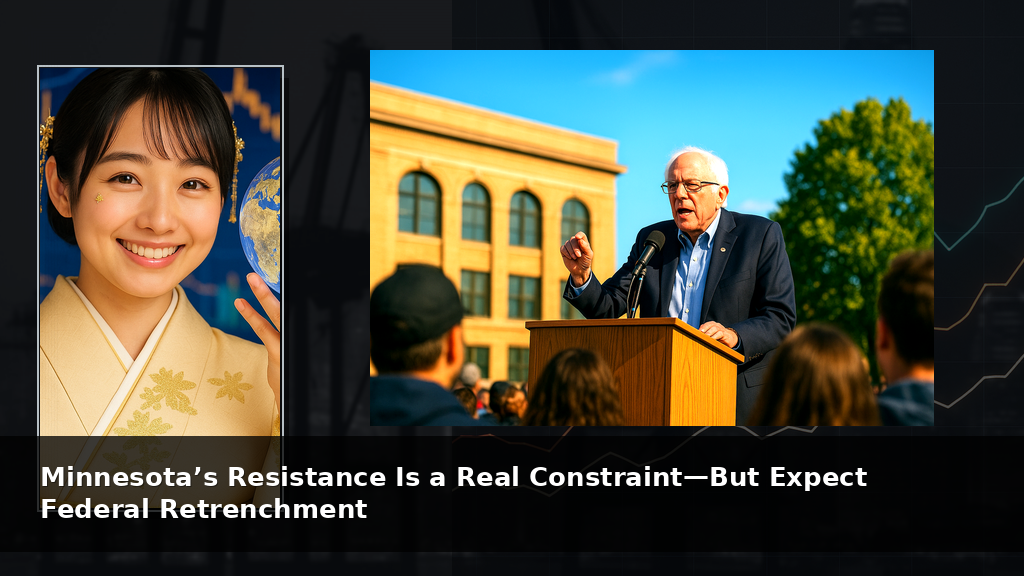
On May 2, 2026, Sen. Bernie Sanders brought his “Fighting Oligarchy” tour to Rochester, Minnesota, endorsing Lt. Gov. Peggy Flanagan before a crowd of about 1,300 at John Marshall High School. (startribune.com) Sanders has repeatedly labeled U.S. Immigration and Customs Enforcement (ICE) as President Trump’s “domestic army,” including on January 30, 2026, while pushing an amendment to redirect proposed ICE funds to Medicaid. (sanders.senate.gov) He has also praised Minnesotans’ resistance to ICE as an inspiration nationally. (english.elpais.com) Those remarks came amid months of unrest after two fatal shootings involving federal agents in Minneapolis on January 7 and January 24. (mprnews.org)
The question that matters: did Minnesota’s mass protests and state‑level legal actions actually constrain the Department of Homeland Security (DHS) and ICE deployments and shift oversight and funding choices, or were they symbolic? Practitioners in government affairs, compliance, and strategy have real exposure: operational risk, workforce stability, and the likelihood of congressional riders all hang on the answer.
Our call: for corporate government‑affairs leads and university/general counsel teams with operations in Minnesota and similar jurisdictions, hedge—treat Minnesota‑style resistance as an operative constraint on large‑scale deployments this year, but plan for tighter, more targeted federal countermeasures rather than a full retreat.
Policy & Legal Structure
The pushback you’ll hear: federal immigration enforcement is preemptive and resilient—street protests don’t move DHS; only Congress and courts do. That frame misses the channel through which Minnesota changed the operating conditions: litigation plus visibility raised the transaction costs of the surge enough to force an executive drawdown and convert the fight into appropriations and oversight venues where constraints become durable.
Start with the legal venue. Minnesota’s Attorney General Keith Ellison, joined by Minneapolis and St. Paul, filed a federal suit in the U.S. District Court for the District of Minnesota (D. Minn.) on January 12 seeking to halt “Operation Metro Surge.” (ag.state.mn.us) Federal judges issued rapid, targeted orders—including limits on certain ICE tactics toward observers and a temporary order ensuring swift access to counsel for detainees—that forced procedural adjustments. (axios.com) Civil‑society plaintiffs added parallel cases that increased docket pressure. (dockets.justia.com)
Then the executive moved. After weeks of protests and two fatal incidents, White House border czar Tom Homan publicly announced on February 12 that the Minnesota surge would conclude and agents would be drawn down. (pbs.org) The operation had involved thousands of federal officers—about 3,000 by late January—magnifying costs and scrutiny. (investing.com) Municipal actions reinforced the pressure: St. Paul enacted an ordinance restricting law‑enforcement staging on city property and requiring identification, and Minneapolis passed a resolution condemning the surge. (stpaul.gov)
Congressional leverage followed. Sanders forced a Senate vote on an amendment to repeal a proposed $75 billion ICE funding increase and redirect those funds to Medicaid—moving the dispute into the appropriations channel even without final passage. (sanders.senate.gov)
There is counter‑pressure: the U.S. Department of Justice (DOJ) served grand‑jury subpoenas on Minnesota officials, signaling a willingness to impose costs on state resistance. (apnews.com) But that is itself evidence of institutional adaptation—not indifference. The net mechanism is clear: mass visibility and coordinated litigation lift the marginal cost of sweeping deployments; the White House trims posture; Congress opens an oversight ledger. The likely equilibrium is fewer large‑scale surges in Minnesota near‑term, paired with more scripted, surgically targeted federal actions and investigatory moves. That is why a hedge—pricing down mass‑sweep risk but up procedural/legal friction—is the right posture.
Nine Star Ki Reading
Nine Purple Fire (Kyushi Kasei, 九紫火星) is the star of public attention and expression; here, it corresponds to Minnesota’s protests and media glare, because the movement converted incidents into sustained, high‑visibility pressure. Six White Metal (Roppaku Kinsei, 六白金星) is the star of command and discipline; here, it maps to DHS/ICE and the White House operational hierarchy, because they set rules, staffing, and deployment precision.
Fire controls Metal (ka-koku-kin, 火剋金), a controlling relation. In this context, heat from public attention does not melt enforcement; it prunes and reshapes it. That implies the drawdown was not simple capitulation but a shift toward tighter rules of engagement, scripted deployments, and legal countermeasures (e.g., subpoenas). This is the rationale for hedging: expect fewer headline‑grabbing surges, more disciplined, targeted activity, and a policy migration into appropriations riders where visibility continues to shape the blade rather than blunt it.
Recommendations
If you are a Fortune 500 government‑affairs lead or a university general counsel with operations and campuses in the Upper Midwest, hedge your enforcement‑risk posture. Build for two simultaneous states: (1) a lower probability of sustained, mass ICE surges in Minnesota this year; (2) a higher probability of targeted actions and legal process that increase compliance, communications, and counsel workload. Prioritize early‑warning on court orders and appropriations language; prepare incident‑response playbooks designed for narrow but intense federal engagements.
- D. Minn. preliminary‑injunction order: grant or deny. Threshold: any preliminary injunction that materially curtails ICE tactics or, conversely, an Eighth Circuit reversal. Horizon: next 3 months.
- DHS/ICE Minnesota staffing memo: redeployment scale. Threshold: ≥1,000 officers redeployed (re‑escalation) or a formal cap <500 (durable constraint). Horizon: monthly checks over 1–6 months.
- Senate Homeland Security appropriations text: funding conditionality. Threshold: adoption of language restraining ICE funding in line with the Sanders amendment, or passage of increased ICE funds without restrictions. Horizon: current FY markup to floor vote (1–4 months).
- DOJ action on Minnesota subpoenas: prosecutorial escalation. Threshold: indictments of state/local officials or public closure with no charges. Horizon: 6–12 months.
Caveats and Open Questions
Three developments would force a rethink:
- DHS/White House reverses course and redeploys ≥1,000 ICE officers to Minnesota with expanded tactics documented in an operations memo—implying the drawdown was tactical noise, not a constraint.
- D. Minn. and/or the Eighth Circuit reject Minnesota’s constitutional/APA theories and deny injunctive relief on appeal—removing the judicial lever that undergirds the constraint thesis.
- Congress passes increased ICE appropriations without meaningful riders—closing the legislative channel and signaling political tolerance for broader deployments.
Three‑choice trigger: which moves first and sets the tone—(1) a D. Minn. preliminary‑injunction order, (2) a DHS/ICE staffing memo redeploying ≥1,000 officers, or (3) Senate adoption of a constraining appropriations rider?