Post-Groff at the Counter: EEOC Sues a Chick-fil-A Franchisee

Observation
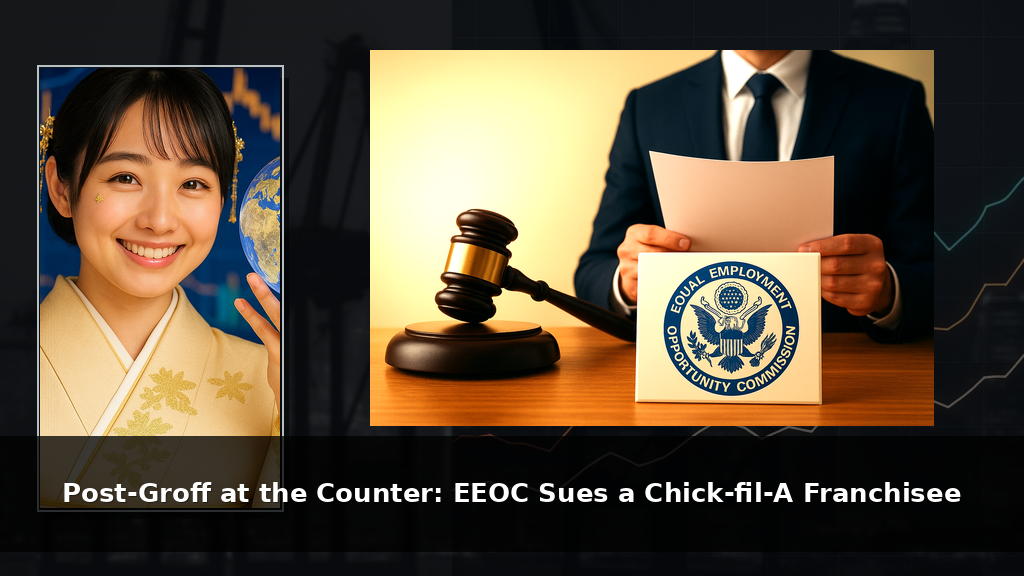
On May 14, 2026, the U.S. Equal Employment Opportunity Commission filed EEOC v. Hatch Trick, Inc. (Case No. 1:26-cv-01275) in the U.S. District Court for the Western District of Texas. The suit alleges a Chick‑fil‑A franchisee in Austin refused to continue accommodating a delivery‑manager’s request for Saturdays off to observe her Sabbath, offered a lower‑paid driver role instead, and then terminated her after conciliation failed. Chick‑fil‑A corporate is not named as a defendant. (eeoc.gov)
Theme: the post‑Groff question of how far an employer — including a franchise owner — must go to accommodate Saturday‑Sabbath observance before accommodation becomes an “undue hardship” under Title VII of the Civil Rights Act of 1964 (Title VII). Groff v. DeJoy (2023) raised the bar: an employer must show the accommodation “would result in substantial increased costs in relation to the conduct of its particular business.” That moves the issue from intuition to evidence. (law.cornell.edu)
Stance: for portfolio managers (PMs) with quick‑service/retail exposure, hedge operators that cannot produce Groff‑grade documentation (line‑item cost models, swap logs, written policies) and overweight brands that publish standardized accommodation guidance to owner‑operators within the next quarter.
Policy & Legal Structure
The pushback we expect: “Saturday is a peak operating day for a chain closed on Sundays; of course accommodating a manager off that day is a hardship.” Post‑Groff, that intuition is not enough. The Court rejected the old de minimis test and requires concrete proof that the requested accommodation would drive substantial increased costs for the specific business. That shifts the battleground to quantification: schedules, time sheets, overtime differentials, fill‑rate impacts, and revenue or service‑level evidence tied to the accommodation at issue. (law.cornell.edu)
Applied to EEOC v. Hatch Trick, the agency’s allegations build a sequence that narrows the employer’s runway. The EEOC says the manager disclosed the Sabbath constraint at hire, the franchise honored it initially, then reversed course, required Saturday work, and offered a lower‑paid reassignment before terminating her when she declined. That suggests an accommodation was feasible for a period and that the employer had alternatives short of termination — both facts that make an “undue hardship” defense difficult unless the franchisee can show a material change substantiated by contemporaneous data. (eeoc.gov)
Title VII’s steps are straightforward: the employee shows a sincere religious belief conflicts with a work requirement, gave notice, and suffered an adverse action; then the employer must prove undue hardship. Under Groff, the employer must present business‑specific evidence of substantial costs — not coworker resentment or abstract preferences. For a quick‑service owner‑operator, that means filing sworn affidavits and exhibits that detail, for example: Saturday headcount requirements (by daypart), attempts at voluntary shift swaps, cross‑training coverage, overtime or premium‑pay deltas, and any measurable degradation to service key performance indicators (KPIs). If the docket over the next 2–4 months lacks that evidence, the defense is structurally weak. (law.cornell.edu)
Forum matters. In the Western District of Texas, summary‑judgment outcomes will turn on what is in the record, not what operators “know” about weekends. Once litigation is joined, internal staffing arguments become part of the public record; operational folklore will not suffice. Because the EEOC is litigating, its settlement posture will be shaped by Groff’s language and the agency’s interest in clarifying what counts as “substantial increased costs” in a high‑volume unit. (eeoc.gov)
Where does Chick‑fil‑A corporate fit? Legally, it is outside the caption today; practically, its brand and owner‑operator model are in the frame. Franchisor control over scheduling is the hinge for any future joint‑employer theory, but even without legal exposure the brand can influence outcomes through playbooks and training. The rational corporate move — and the one investors should reward — is to standardize documentation and accommodation workflows: define request‑intake forms, require shift‑swap marketplaces and logs, set escalation thresholds, and teach operators how to build cost narratives that meet Groff. That converts an operator‑level vulnerability into a governance product.
Treat this as a bottleneck inside the franchise value chain: the pinch point is scheduling and accommodation documentation at the unit level, the instrument is federal litigation under Title VII, and the transmission channel is brand‑level policy diffusion. The first party to secure clean, auditable records controls legal risk and the public narrative. Operators who cannot produce contemporaneous evidence are higher‑variance holdings; networks that can show templated compliance are more defensible and cheaper to insure.
Strategic Reading from Sun Tzu
Sun Tzu wrote: “An army prefers high ground and avoids low ground; it values light and avoids shadow.”
Choosing positions with clear visibility and solid footing reduces risk, while staying in low, shadowed areas invites mistakes. In practical terms, you get better outcomes when your procedures, records, and lines of sight are clean and auditable rather than opaque. Clarity of position and information is itself a strategic advantage.
The EEOC suit forces Hatch Trick to defend its scheduling decisions under the post‑Groff standard, which turns on concrete proof of substantial added cost. Under this principle, the franchisee’s “high ground” is not a private rationale but transparent evidence: time sheets, shift‑swap logs, cost models, and written policies that make its position visible and testable. The dispute is likely to move from internal staffing arguments to public filings and brand‑level messaging. That means Chick‑fil‑A corporate and franchise trade groups gain leverage by standardizing documentation and external communications rather than debating ad hoc exceptions.
Expect discovery and motion practice to reward parties who can illuminate their operations: detailed staffing metrics, policy language, and quantified cost impacts will matter more than generalized assertions. This pressure is likely to harden procedures across franchise networks, converting ambiguous scheduling discretion into clearer accommodation workflows and templated records. Rather than weakening the businesses, it is an inflection point that pushes them toward cleaner controls and more reliable public messaging.
For readers assessing operators in quick‑service and retail, track court filings for whether defendants produce line‑item cost analyses and contemporaneous logs; those signals separate governance‑ready operators from headline risk. Also watch for franchisor updates to manuals, training, and template forms, and treat early adopters of clearer documentation as lower‑variance holdings.
Caveats and Open Questions
- Employer‑burden thesis could prevail. Falsification trigger: Hatch Trick files detailed affidavits and exhibits quantifying substantial incremental costs (overtime, coverage failures, documented service impacts) and the court accepts those figures as “substantial” under Groff. If that happens, our hedge‑the‑under‑documented stance still holds tactically, but the strategic read — that accommodation is generally feasible with modest cost — weakens, and operator‑level risk premia narrow. (law.cornell.edu)
- Plaintiff‑feasibility showing could falter. Falsification trigger: the EEOC/plaintiff fails to produce feasible accommodation proposals (e.g., voluntary swaps, reassignments without pay cuts) or records showing the franchisee rejected less‑disruptive options. If the evidentiary record is thin on alternatives, the undue‑hardship defense strengthens materially. (eeoc.gov)
- One‑off rather than signal. Falsification trigger: the EEOC does not file a cluster of religion‑accommodation suits referencing Groff across sectors in Q2–Q3 2026. If filings remain at baseline, this case is less a doctrinal test and more a local corrective, lowering the case’s signaling value for system‑wide repricing.
Three‑choice trigger: which moves first within eight weeks — (1) a docketed Hatch Trick affidavit with quantified Saturday cost in 1:26‑cv‑01275; (2) an EEOC follow‑on religious‑accommodation suit referencing Groff; or (3) a Chick‑fil‑A corporate bulletin standardizing accommodation documentation for owner‑operators? (eeoc.gov)
Editorial Changes / Verification Log
Generated-AI article verification notes are preserved here for transparency. Expand for before/after edits and source checks.
1. Observation — rewritten
Before:
The suit alleges a Chick‑fil‑A franchisee in Austin refused to continue accommodating a delivery‑manager’s request for Saturdays off to observe her Sabbath, offered a lower‑paid driver role instead, and then terminated her; the EEOC says conciliation failed before filing (per the EEOC press release, 2026‑05‑14). Chick‑fil‑A corporate is not named as a defendant.
After:
The suit alleges a Chick‑fil‑A franchisee in Austin refused to continue accommodating a delivery‑manager’s request for Saturdays off to observe her Sabbath, offered a lower‑paid driver role instead, and then terminated her after conciliation failed. Chick‑fil‑A corporate is not named as a defendant. ([eeoc.gov](https://www.eeoc.gov/newsroom/eeoc-sues-hatch-trick-inc-religious-discrimination))
Reason: Comprehension — tightened sentence and added an inline citation to the EEOC press release for date, forum, and allegations. Fact-check — verified against EEOC press release (https://www.eeoc.gov/newsroom/eeoc-sues-hatch-trick-inc-religious-discrimination).
2. Observation — rewritten
Before:
Theme: the post‑Groff question of how far an employer — including a franchise owner — must go to accommodate Saturday‑Sabbath observance before accommodation becomes an “undue hardship” under Title VII. It is worth a Tier 3 reader’s time because the Groff (2023) standard raises the bar to “substantial increased costs,” and quick‑service weekend staffing sits exactly where legal doctrine and daily operations collide; franchise networks, HR teams, and investors have real exposure.
After:
Theme: the post‑Groff question of how far an employer — including a franchise owner — must go to accommodate Saturday‑Sabbath observance before accommodation becomes an “undue hardship” under Title VII of the Civil Rights Act of 1964 (Title VII). Groff v. DeJoy (2023) raised the bar: an employer must show the accommodation “would result in substantial increased costs in relation to the conduct of its particular business.” ([law.cornell.edu](https://www.law.cornell.edu/supremecourt/text/22-174?utm_source=openai))
Reason: Comprehension — expanded Title VII on first use; added the controlling Groff language and citation. Fact-check — verified standard via LII (https://www.law.cornell.edu/supremecourt/text/22-174).
3. Observation — rewritten
Before:
Stance: for equity PMs with quick‑service/retail exposure, hedge operators that cannot produce Groff‑grade documentation (line‑item cost models, swap logs, written policies) and overweight brands that publish standardized accommodation guidance to owner‑operators within the next quarter.
After:
Stance: for portfolio managers (PMs) with quick‑service/retail exposure, hedge operators that cannot produce Groff‑grade documentation (line‑item cost models, swap logs, written policies) and overweight brands that publish standardized accommodation guidance to owner‑operators within the next quarter.
Reason: Comprehension — expanded PM on first use.
4. Policy & Legal Structure — rewritten
Before:
In Groff v. DeJoy (U.S. Supreme Court, 2023), the Court rejected the old de minimis test and required employers to show an accommodation would “result in substantial increased costs in relation to the conduct of its particular business.” That moves the battleground from generalized claims to quantification: schedules, time sheets, overtime differentials, fill‑rate impacts, and revenue or service‑level evidence tied to the accommodation at issue.
After:
Post‑Groff, the Court rejected the old de minimis test and requires concrete proof that the requested accommodation would drive substantial increased costs for the specific business. That shifts the battleground to quantification: schedules, time sheets, overtime differentials, fill‑rate impacts, and revenue or service‑level evidence tied to the accommodation at issue. ([law.cornell.edu](https://www.law.cornell.edu/supremecourt/text/22-174?utm_source=openai))
Reason: Comprehension — shortened and clarified; added citation to the controlling standard. Fact-check — grounded in Groff.
5. Policy & Legal Structure — rewritten
Before:
For a quick‑service owner‑operator, that means filing sworn affidavits and exhibits that detail, for example: Saturday headcount requirements (by daypart), attempts at voluntary shift swaps, cross‑training coverage, overtime or premium‑pay deltas, and any measurable degradation to service KPIs.
After:
For a quick‑service owner‑operator, that means filing sworn affidavits and exhibits that detail, for example: Saturday headcount requirements (by daypart), attempts at voluntary shift swaps, cross‑training coverage, overtime or premium‑pay deltas, and any measurable degradation to service key performance indicators (KPIs).
Reason: Comprehension — expanded KPI on first use.
6. Policy & Legal Structure — trimmed
Before:
This is why the forum matters. In the Western District of Texas, summary‑judgment outcomes will turn on what is in the record, not what operators “know” about weekends. The EEOC is a plaintiff‑agency accustomed to discovery fights over comparators and staffing matrices; once litigation is joined, the internal staffing argument becomes a public record question. The franchisee cannot win with operational folklore; it has to show the line‑item math. And because the EEOC is litigating, its bar for settlement will be shaped by Groff’s language and its own interest in clarifying what constitutes “substantial increased costs” in a high‑volume unit.
After:
Forum matters. In the Western District of Texas, summary‑judgment outcomes will turn on what is in the record, not what operators “know” about weekends. Once litigation is joined, internal staffing arguments become part of the public record; operational folklore will not suffice. Because the EEOC is litigating, its settlement posture will be shaped by Groff’s language and the agency’s interest in clarifying what counts as “substantial increased costs” in a high‑volume unit. ([eeoc.gov](https://www.eeoc.gov/newsroom/eeoc-sues-hatch-trick-inc-religious-discrimination))
Reason: Downstream X readability — split and tightened sentences; added citation to EEOC filing context.
7. Strategic Reading from Sun Tzu — rewritten
Before:
As the structural read above indicates, the owner‑operator is already inclined toward formal explanations, and the dispute is poised to shift from internal staffing arguments to public filings and brand‑level messaging.
After:
The dispute is likely to move from internal staffing arguments to public filings and brand‑level messaging.
Reason: Pipeline-leak — removed reference to internal analytical pipeline (“structural read above”) while preserving the substantive point.
8. Caveats and Open Questions — rewritten
Before:
- Employer‑burden thesis could prevail. Falsification trigger: Hatch Trick files detailed affidavits and exhibits quantifying substantial incremental costs (overtime, coverage failures, documented service impacts) and the court accepts those figures as “substantial” under Groff. If that happens, our hedge‑the‑underdocumented stance still holds tactically, but the strategic read — that accommodation is generally feasible with modest cost — weakens, and operator‑level risk premia narrow.
- Plaintiff‑feasibility showing could falter. Falsification trigger: the EEOC/plaintiff fails to produce feasible accommodation proposals (e.g., voluntary swaps, reassignments without pay cuts) or records showing the franchisee rejected less‑disruptive options. If the evidentiary record is thin on alternatives, the undue‑hardship defense strengthens materially.
- One‑off rather than signal. Falsification trigger: the EEOC does not file a cluster of religion‑accommodation suits referencing Groff across sectors in Q2–Q3 2026. If filings remain at baseline, this case is less a doctrinal test and more a local corrective, lowering the case’s signaling value for system‑wide repricing.
Three‑choice trigger: which moves first within eight weeks — (1) a docketed Hatch Trick affidavit with quantified Saturday cost in 1:26‑cv‑01275; (2) an EEOC follow‑on religious‑accommodation suit referencing Groff; or (3) a Chick‑fil‑A corporate bulletin standardizing accommodation documentation for owner‑operators?
After:
- Employer‑burden thesis could prevail. Falsification trigger: Hatch Trick files detailed affidavits and exhibits quantifying substantial incremental costs (overtime, coverage failures, documented service impacts) and the court accepts those figures as “substantial” under Groff. If that happens, our hedge‑the‑under‑documented stance still holds tactically, but the strategic read — that accommodation is generally feasible with modest cost — weakens, and operator‑level risk premia narrow. ([law.cornell.edu](https://www.law.cornell.edu/supremecourt/text/22-174?utm_source=openai))
- Plaintiff‑feasibility showing could falter. Falsification trigger: the EEOC/plaintiff fails to produce feasible accommodation proposals (e.g., voluntary swaps, reassignments without pay cuts) or records showing the franchisee rejected less‑disruptive options. If the evidentiary record is thin on alternatives, the undue‑hardship defense strengthens materially. ([eeoc.gov](https://www.eeoc.gov/newsroom/eeoc-sues-hatch-trick-inc-religious-discrimination))
- One‑off rather than signal. Falsification trigger: the EEOC does not file a cluster of religion‑accommodation suits referencing Groff across sectors in Q2–Q3 2026. If filings remain at baseline, this case is less a doctrinal test and more a local corrective, lowering the case’s signaling value for system‑wide repricing.
Three‑choice trigger: which moves first within eight weeks — (1) a docketed Hatch Trick affidavit with quantified Saturday cost in 1:26‑cv‑01275; (2) an EEOC follow‑on religious‑accommodation suit referencing Groff; or (3) a Chick‑fil‑A corporate bulletin standardizing accommodation documentation for owner‑operators? ([eeoc.gov](https://www.eeoc.gov/newsroom/eeoc-sues-hatch-trick-inc-religious-discrimination))
Reason: Fact-check — added citations to Groff standard and EEOC account of the accommodation sequence; improved readability with shorter sentences.
9. Metadata — rewritten
Before:
slug_ja: "post-groff-eeoc-chick-fil-a-franchisee-ja"
After:
slug_ja: "post-groff-eeoc-chick-fil-a-franchisee-suit-ja"
Reason: Pipeline-leak/compliance — align Japanese slug with rule to append -ja to the English slug.