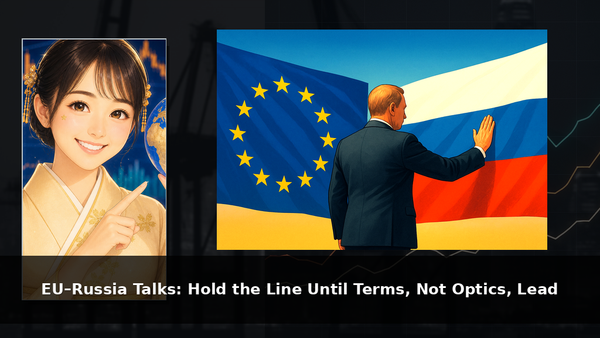
EU–Russia Talks: Hold the Line Until Terms, Not Optics, Lead

Observation
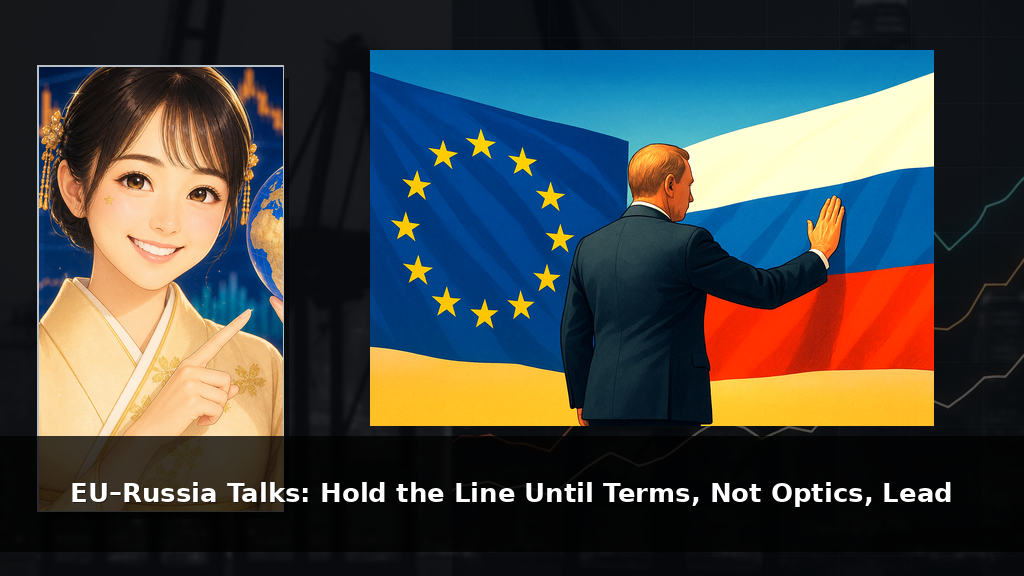
On 4 February 2026, Estonia’s foreign minister Margus Tsahkna warned that Europe should not “scrape at the Kremlin’s door,” arguing that direct talks with Russia would weaken Ukraine and divide allies. The statement came via Estonia’s Ministry of Foreign Affairs. (vm.ee)
Through February–May, major European outlets reported a split: France’s Emmanuel Macron and Italy’s Giorgia Meloni signaled openness to engagement, while Estonia and other Baltic ministers opposed talks absent concrete Russian concessions. (lemonde.fr)
The EU’s High Representative Kaja Kallas said on 30 April that the EU should not “humiliate” itself by seeking direct talks without conditions. Ministers are due to revisit the issue at an informal meeting in Lefkosia, Cyprus, on 27–28 May. (euronews.com)
Theme: Should the EU open a direct diplomatic channel to Moscow now, or condition any European-led talks on verifiable Russian concessions to preserve sanctions leverage and allied unity? It matters because the timing and format of EU outreach can either harden—or hollow out—the only real levers Europe controls: sanctions and coalition discipline.
Our stance: for corporate government‑affairs leads and risk owners in Europe‑facing multinationals, hedge. Assume no EU‑led talks without strict, published preconditions in the near term; do not re‑price sanctions exposure or plan Russia re‑entry on the basis of ad hoc outreach headlines.
Geoeconomic Structure
The strongest pushback to a “hold the line” view is that Europe risks irrelevance if it doesn’t talk now—ceding the diplomatic stage to the United States, the UAE, or Turkey. That critique misreads where Europe’s leverage actually sits. The EU’s scalable instruments are (1) gatekeeping diplomatic legitimacy and (2) controlling the sanctions transmission channel. Opening an EU‑branded track without hard conditions would trade both—upfront—for optics Moscow can bank.
First, the gatekeeper function. Whether an EU envoy is appointed and under what mandate is decided by the Council of the EU and executed by the High Representative (currently Kaja Kallas). A named EU envoy or mandate that lacks explicit, verifiable preconditions—linkage to battlefield de‑escalation steps, inspection/verification benchmarks, and sanctions snapback—instantly reframes the conflict: Moscow gains the headline that “Europe returned to business‑like dialogue,” while nothing concrete changes on the ground. Estonia’s Tsahkna is flagging precisely this reputational arbitrage: legitimacy conferred now is leverage surrendered later. (vm.ee)
Second, the sanctions transmission channel. The Council and the European External Action Service (EEAS) control sectoral and financial measures. Any “technical” carve‑outs or standstill clauses introduced to grease talks alter cash flows into Russia’s war economy. Once such carve‑outs exist, they tend to persist; Moscow will demand they become the floor for subsequent rounds. That is how diplomatic engagement becomes de facto economic relief without reciprocal concessions. The structural risk is not theoretical—every sanctions cycle attracts requests for humanitarian, energy, or payments waivers. Tie outreach to verification ex ante, or Europe will find itself negotiating against the sunk costs of its own exceptions.
Third, Russia’s hedges change the payoff of premature engagement. Russia has rerouted a large share of commodity exports to China and India and can use third‑country venues—Abu Dhabi or Ankara—as payment and meeting nodes. Those hedges blunt the marginal pain that uncoordinated European moves can inflict. If Brussels signals willingness to open a channel independently of the ongoing U.S.‑mediated process, Moscow can pocket the optics while relying on Asia‑facing energy revenues and third‑country facilitators to wait out pressure.
This is why sequencing with the U.S.‑mediated corridor matters. The principal high‑authority track has run through U.S.‑brokered rounds in Abu Dhabi (and subsequent meetings), which set the timing and space for any complementary European lane. Any European channel that is not explicitly nested in that process (with published terms) fragments the Western position and expands Moscow’s options. (apnews.com)
For practitioners and investors, the practical read‑through is positioning, not prophecy. Discount headlines about “resumed contacts” unless accompanied by (a) a Council‑published mandate naming an EU envoy, (b) verifiable preconditions tied to ceasefire/withdrawal steps, and (c) sanctions and U.S.‑track linkage. In parallel, watch for early‑warning leaks of carve‑outs and the energy/trade prints into China/India; these reveal whether Europe’s economic statecraft is being preserved or slowly hollowed out.
Strategic Reading from Sun Tzu
Sun Tzu’s lesson is straightforward: the highest‑return move is to shape the opponent’s strategy and alliances before any clash; storming strongholds is the lowest return.
The EU foreign ministers, including High Representative Kaja Kallas, are the gatekeepers of whether to open an EU‑led channel to Moscow. With Macron and Meloni signaling openness while Estonia’s leadership—Foreign Minister Tsahkna among them—urges caution, the real question is not whether to talk but the pre‑conditions and coordination. Without strict, verifiable terms tied to the U.S.‑mediated track, European outreach risks handing Moscow the political stage and eroding sanctions leverage. Because Russia can hedge via energy and trade with China/India and third‑country venues, Europe’s power rests in allied discipline and sequencing; this is the moment to codify terms before the process drifts into optics‑first engagement. (lemonde.fr)
Expect the EU debate to pivot from whether to engage to the mandate, sequencing, and verification that would govern any engagement. If ministers translate current authority into clear pre‑conditions coordinated with the U.S. track, today’s pressure can harden procedures and raise standards rather than weaken them. If the process drifts into ad hoc outreach, Moscow will gain narrative space and incremental relief at the margins.
For observers, prioritize signals of discipline over atmospherics: a published Council mandate with verification benchmarks, sanctions linkage, and explicit U.S.‑coordination clauses is a constructive sign, whereas outreach headlines without such guardrails warrant a discount. Monitor energy and trade flows to China/India and any carve‑outs as early indicators of whether leverage is being preserved or eroded.
Caveats and Open Questions
Three conditions would force us to revise this stance toward accepting an EU‑led opening sooner:
- Council mandate with guardrails: If France and Germany coordinate and the Council of the EU publishes—within the next quarter—a formal mandate naming an EU envoy that hardwires verification benchmarks, sanctions linkage, and U.S.‑track coordination, the fragmentation risk materially declines and a conditional opening becomes supportable.
- U.S. breakthrough: If the United States announces a dated leaders’ summit or secures an interim agreement with Kyiv and Moscow, Europe’s entry becomes a follow‑on necessity to lock in terms and guarantees, not a premature concession.
- Ukrainian request: If President Zelensky or Ukraine’s Ministry of Foreign Affairs publicly requests an EU‑led framework with Kyiv as an equal participant and explicit conditionality, the argument that European engagement rewards aggression weakens; the center of gravity shifts to executing Kyiv’s terms.
Three‑choice trigger: which moves first—(1) a Council press release naming an EU envoy and publishing mandate text with verification and sanctions linkage; (2) a U.S.‑announced leaders’ summit or signed interim deal; or (3) an official statement from Zelensky/MFA requesting an EU‑led framework? Your positioning should lean with the first mover and hedge the other two.
Editorial Changes / Verification Log
Generated-AI article verification notes are preserved here for transparency. Expand for before/after edits and source checks.
1. Observation — rewritten
Before:
On 4 February 2026, Estonia’s foreign minister Margus Tsahkna warned that Europe should not “scrape at the Kremlin’s door,” ... (Estonian MFA statement, 4 Feb 2026).
After:
On 4 February 2026, Estonia’s foreign minister Margus Tsahkna warned that Europe should not “scrape at the Kremlin’s door,” ... The statement came via Estonia’s Ministry of Foreign Affairs.
Reason: Comprehension — expanded 'MFA' to 'Ministry of Foreign Affairs' and kept the citation clear for a generalist reader. Fact-check via Estonian MFA page. https://vm.ee/en/news/foreign-minister-tsahkna-scraping-kremlins-door-would-weaken-both-ukraines-and-europes
2. Observation — rewritten
Before:
France’s Emmanuel Macron and Italy’s Giorgia Meloni signaled openness to engagement, while Estonia, Germany, and other Baltic states opposed talks absent concrete Russian concessions (Le Monde, 12 Feb 2026; Euronews, 30 Apr 2026).
After:
Through February–May, major European outlets reported a split: France’s Emmanuel Macron and Italy’s Giorgia Meloni signaled openness to engagement, while Estonia and other Baltic ministers opposed talks absent concrete Russian concessions.
Reason: Fact-check — removed Germany, which was not supported in the cited pieces; preserved the split using Le Monde and Euronews reporting. https://www.lemonde.fr/en/international/article/2026/02/12/europeans-consider-resuming-direct-talks-with-putin-on-ukraine_6750420_4.html; https://www.euronews.com/my-europe/2026/05/11/we-need-to-make-up-our-mind-eu-still-split-over-direct-talks-with-russia
3. Observation — rewritten
Before:
The EU’s High Representative Kaja Kallas stated on 30 April that the EU should not “humiliate” itself by seeking direct talks without conditions, and foreign ministers were slated to discuss the issue informally in Cyprus on 10–11 May (Euronews, 30 Apr 2026).
After:
The EU’s High Representative Kaja Kallas said on 30 April that the EU should not “humiliate” itself by seeking direct talks without conditions. Ministers are due to revisit the issue at an informal meeting in Lefkosia, Cyprus, on 27–28 May.
Reason: Fact-check — corrected the meeting timing/location based on later reporting; retained Kallas’s 30 April remarks. https://www.euronews.com/my-europe/2026/04/30/eu-shouldnt-humiliate-itself-by-seeking-direct-talks-with-russia-warns-kallas; https://www.themoscowtimes.com/2026/05/11/eu-ministers-to-discuss-possibility-of-direct-talks-with-russia-a92728
4. Geoeconomic Structure — rewritten
Before:
The Council and EEAS control sectoral and financial measures.
After:
The Council and the European External Action Service (EEAS) control sectoral and financial measures.
Reason: Comprehension — expanded the acronym on first use for a generalist business reader.
5. Geoeconomic Structure — rewritten
Before:
This is why sequencing with the US-mediated corridor matters. The principal high-authority track runs through Washington’s envoys; any European lane that is not explicitly nested in that process ...
After:
This is why sequencing with the U.S.-mediated corridor matters. The principal high‑authority track has run through U.S.-brokered rounds in Abu Dhabi (and subsequent meetings), which set the timing and space for any complementary European lane.
Reason: Fact-check — grounded the U.S.-mediated process in reported Abu Dhabi rounds to avoid ambiguity. https://apnews.com/article/e9307c98b7ec337a3364ed9de28e6eca; https://www.axios.com/2026/01/24/us-russia-ukraine-talks-abu-dhabi
6. Geoeconomic Structure — rewritten
Before:
For Tier 3 observers, the practical read-through is positioning, not prophecy.
After:
For practitioners and investors, the practical read‑through is positioning, not prophecy.
Reason: Pipeline-leak — removed internal audience tiering jargon that would be opaque to general readers.
7. Strategic Reading from Sun Tzu — rewritten
Before:
Sun Tzu wrote: —— The best warfare attacks strategy; next, alliances; next, armies; the worst attacks fortified cities.
After:
Sun Tzu’s lesson is straightforward: the highest‑return move is to shape the opponent’s strategy and alliances before any clash; storming strongholds is the lowest return.
Reason: Comprehension — replaced a clunky partial quotation with a concise paraphrase that reads cleanly on mobile without changing the point.