Moderates Tip Denmark Right—Hedge a Fragile Poulsen Mandate

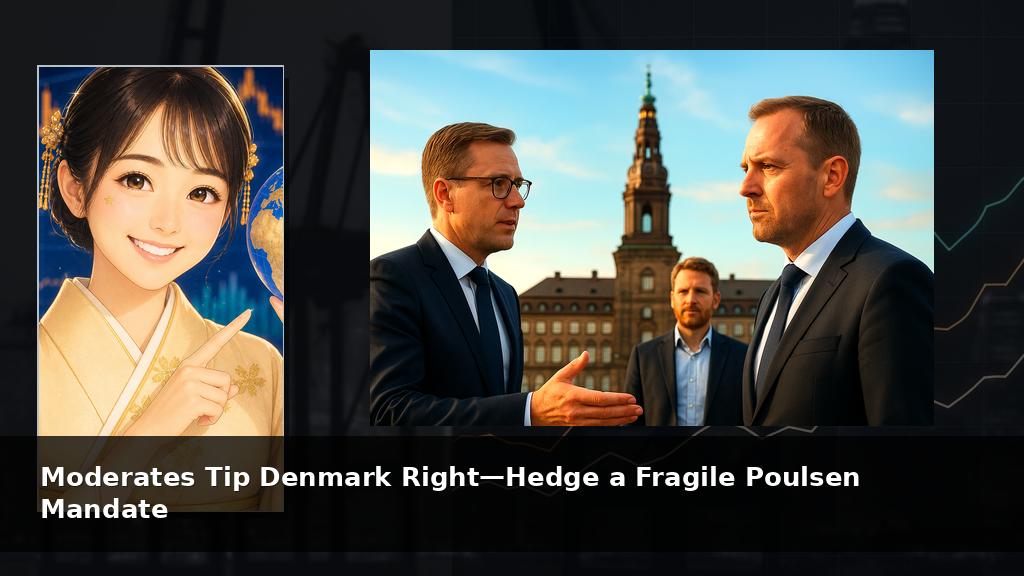
Source: https://x.com/i/status/2052905154022609190
Observation
Denmark’s 24 March 2026 snap election produced a hung Folketing. The Social Democrats won 38 seats; the left‑leaning bloc tallied about 84 seats and the right‑leaning bloc about 77, leaving the Moderates (~14) pivotal (AP News, 24 Mar 2026; Reuters, 24–25 Mar 2026). On 25 March, King Frederik X asked Prime Minister Mette Frederiksen to lead coalition talks as the royal formateur. After weeks of stalemate, the King on 8 May requested Venstre leader Troels Lund Poulsen to lead the next round of negotiations following party recommendations—including from the Moderates—representing 87 seats (Royal House of Denmark/Kongehuset, 8 May 2026).
Theme: whether the Moderates (Lars Løkke Rasmussen) have pivoted government formation toward a blue/right‑leaning outcome by endorsing a Venstre formateur. It matters because the formateur switch reallocates bargaining leverage, reshapes fiscal and immigration policy expectations, and sets the near‑term stability risk for Nordic assets and EU‑facing corporate plans.
Stance: For equity PMs and corporate gov‑affairs teams with Denmark exposure, hedge the blue pivot as real but fragile. Do not fully price a durable policy turn until the Royal House publishes a ≥90‑seat pledge or a signed framework; treat a Poulsen‑led minority as probable but short‑half‑life.
Policy & Legal Structure
A skeptic’s first pushback is that the monarch’s role is ceremonial and the math decides. In normal times that is directionally right. But the formateur mandate—the King’s formal request after a royal round of consultations (kongerunde)—decides who controls the next agenda and pressures fence‑sitters. On 25 March, that leverage sat with Frederiksen; as of 8 May, it sits with Poulsen because a cluster of non‑socialist parties plus the Moderates recommended him (Kongehuset press notices). The switch does not predetermine the government—but it changes the venue of decision from “can the Social Democrats knit a centrist extension?” to “can Venstre convert blue preferences plus Moderate leverage into 90 seats?”
The mechanism runs through three layers. First, the royal request is a procedural chokepoint: the formateur convenes, sets the sequence of bilateral meetings, and can table a draft platform to test the room. In that role, Poulsen can translate latent blue‑bloc preferences (Conservatives, Liberal Alliance, Danish People’s Party, Danmarksdemokraterne, and smaller non‑socialist actors) into a concrete seat tally. Second, the Moderates are the decisive veto player. With roughly 14 seats, they determine whether a right‑leaning constellation can credibly claim a working majority or at least a stable confidence‑and‑supply pact (support on confidence and budgets without joining the cabinet). Their 8 May recommendation raised the expected value of a blue outcome versus a centrist hybrid. Third, parliamentary arithmetic still governs the endgame: without ≥90 pledged seats, Poulsen must return the mandate and trigger another round of royal consultations.
Why hedge rather than buy the blue turn outright? Because the Moderates’ optimal bargaining path is to price their pivotal position, not to donate it. A full blue coalition that simply counts their seats (≈77 blue + ≈14 Moderates ≈ 91) is arithmetically viable but politically expensive: each partner will demand portfolio and policy concessions, and several have divergent red lines—e.g., Liberal Alliance and Danmarksdemokraterne differ on spending and immigration calibration. A minority Venstre‑led arrangement with confidence‑and‑supply from some combination of Conservatives, Liberal Alliance, and Denmark Democrats could form more quickly, but would be inherently fragile—one defection away from crisis and likely to govern under constant threat of confidence votes.
The formateur switch also weakens the traditional “largest‑party‑leads” norm. That normalisation of king‑mediated reassignment elevates the market price of kingmaker seats in future cycles and increases the probability of short‑duration governments. For corporate planners, that means policy direction can swing at the margin (fiscal tone, immigration enforcement, elements of climate/energy pacing), but durability is the scarce asset. The operational test is simple and externally observable: either we see a Royal House‑acknowledged pledge sheet that sums to ≥90 seats or we don’t. Until such a document or a signed coalition framework appears, the correct posture is to assume a Poulsen attempt will proceed, but with higher‑than‑usual failure and early‑election risk priced in.
Nine Star Ki Reading
Read as a leadership figure, the Moderates under Lars Løkke Rasmussen are best understood through Six White Metal (Roppaku Kinsei, 六白金星), matching the image of a ministerial authority (“大臣”)—status‑conscious, institution‑anchored, and comfortable directing the room. Different lenses would emphasize different traits, but the leadership lens is the one that moves the formation process.
The background here is establishment authority: a party and leader used to operating through hierarchy and formal channels, with a bias toward control rather than ideological brinkmanship. What is showing now is command in public—standing at Northwest (Kenkyū, 乾宮)—the place of overt direction and visible responsibility. The two are aligned: this is not bluffing for optics; it is a pivot executed from real institutional weight. For the observer, alignment means the Moderates’ endorsement genuinely shifts leverage rather than merely signalling frustration with the center‑left.
In the cycle, standing at Northwest moves next to West (Dakyū, 兌宮). Translation: the current command posture must convert into exchange—deals, messaging, reputational trade‑offs. The practical read‑through is straightforward: the Moderates’ assertion has bought them the microphone, but the next phase is persuasion under bright lights. If coalition partners extract high reputational costs, the center’s turbulence will test this posture quickly; a written pact or pledge sheet is the only durable output that resolves it.
Recommendations
If you are an equity PM with Nordic exposure, a corporate gov‑affairs lead planning Denmark/EU engagement for 2H26, or a macro strategist setting fiscal/immigration sensitivities, hedge the blue pivot. Engage on Venstre‑led policy priorities and scenario‑test a right‑leaning minority, but do not over‑weight a durable shift until there is a Royal House‑referenced ≥90‑seat pledge or a signed coalition framework. Treat a near‑term Poulsen cabinet as plausible; treat policy durability as discounted.
Watch the following markers with numeric gates:
- Royal House pledge tally: a press notice or submissions page listing a Poulsen‑led arrangement claiming ≥90 pledged seats within 3 weeks of 8 May (by the week of 27 May 2026) upgrades odds of a functioning blue government.
- Signed framework: a publicly posted agreement by Venstre plus at least two of Conservatives/Liberal Alliance/Denmark Democrats stating a seat count ≥90 within 30 days (by 7 June 2026) converts the mandate into governance; absent by day 30, increase the fragility discount.
- Moderates reversal: a clear public statement by Lars Løkke Rasmussen withdrawing endorsement for Poulsen or re‑endorsing a cross‑bloc formateur within 14 days (by 22 May 2026) would invalidate the blue‑pivot thesis and re‑open a centrist configuration.
- Mandate return: Poulsen formally returning the mandate without a ≥90 pledge within 4 weeks (by 5 June 2026) triggers a reset; shift the base case back to stalemate/centrist bargaining.
Caveats and Open Questions
- Moderates could reverse course. If Lars Løkke Rasmussen withdraws his recommendation for Poulsen or re‑endorses Frederiksen/a cross‑bloc formateur in the next 2–4 weeks, the blue pivot evaporates and the stance must shift from hedge‑blue to neutral‑center.
- No 90‑seat proof appears. If there is no Royal House‑acknowledged ≥90‑seat pledge and no signed framework within one month of 8 May, confidence in any Poulsen government should drop sharply; re‑price for a short‑lived minority or a renewed kongerunde.
- Blue‑bloc cohesion fails. If Conservatives, Liberal Alliance, Dansk Folkeparti, or Danmarksdemokraterne publicly refuse confidence‑and‑supply under Poulsen’s platform, the arithmetic breaks; downgrade probability of a blue cabinet and re‑elevate cross‑bloc scenarios.
Lead‑time question: how many weeks until a Royal House filing shows a Poulsen‑led ≥90‑seat pledge—within 3 weeks, within 6 weeks, or not this summer—and are you positioned for that timing or hedged for another reset?