Hormuz Talks: Reopen Now, Leverage Later — Hedge the Relief Rally

Source: https://x.com/i/status/2052485021030654071
Observation
On May 7, 2026, Reuters and the Associated Press reported that U.S. and Iranian officials — with Pakistan mediating — are discussing a brief memorandum to end hostilities and create a 30‑day window to reopen the Strait of Hormuz and negotiate remaining issues. Markets faded tension on the headline: Brent front‑month traded around $98 per barrel (roughly a 3% intraday drop). The U.S. paused its naval escort effort (“Project Freedom”) on May 5, citing progress in talks, while AP reported hundreds of commercial vessels bottled up awaiting clarity. (gmanetwork.com)
The theme is sequencing: does a short, 30‑day reopening before nuclear and proxy questions are settled deliver durable de‑escalation, or merely buy Tehran reversible leverage over a chokepoint that moves the oil market? It matters because shippers, insurers, and energy‑linked equities will be asked to normalize fast, while the bargaining chips that created leverage remain unresolved.
Our stance: if you are an equity PM with energy exposure or a Fortune 500 supply‑chain lead reliant on Gulf flows, hedge the relief rally. Treat any reopening as reversible until three things are visible in data: insurer de‑listings of war‑risk areas, verifiable transit counts rising, and a credible escort/permit regime. Do not re‑price to “durable normalization” during the 30‑day window without those confirmations.
Geoeconomic Structure
A skeptical read starts here: if politicians say “we’re reopening,” why not treat that as decisive? Because Hormuz is not opened by communiqués; it is opened by a stack of operational gatekeepers who must all turn keys in sequence.
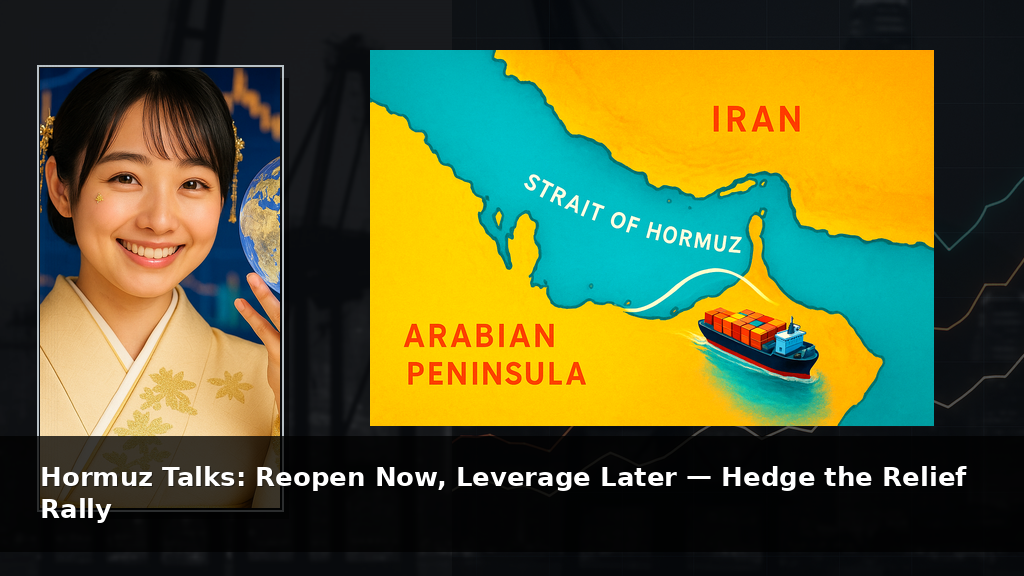
First, the chokepoint. The Strait of Hormuz is the physical bottleneck for Persian Gulf crude, LNG, and container/bulk flows. A memorandum does not, by itself, clear a lane; it must be translated into permits and safe‑passage norms. AP, citing Lloyd’s List Intelligence, reported that Iran created a new “Persian Gulf Strait Authority” alongside the Iranian Navy to vet and tax transits — converting ad‑hoc interdiction into an administrable lever. That is reversible leverage by design. (apnews.com)
Second, the underwriting gate. Even if a memorandum is inked, vessel movements will not normalize unless the Lloyd’s Market Association (LMA) Joint War Committee (JWC) narrows or removes the Persian Gulf/Gulf of Oman from its “Listed Areas,” and protection and indemnity (P&I) clubs (Skuld, Gard, London P&I, others) reinstate workable war‑risk cover. Owners, charterers, and banks take their cue from those circulars; absent cover, most ships will wait out the risk. This is the finance‑as‑infrastructure layer of the chokepoint: no cover, no cargo. (maritimecyprus.com)
Third, credible protection. Naval escorts are the bridge between words and flows. The U.S. Navy’s “Project Freedom” pause was framed as a bet on talks; if escorts remain on the sidelines while terms are still ambiguous, operators will discount the memo’s safety guarantees. Conversely, if escorts resume under an agreed routing protocol, insurers gain the justification to narrow risk premia. The escort posture is the enforcement mechanism that turns administrative promises into real‑world probabilities.
Fourth, substitution capacity. Saudi Arabia’s East‑West (Petroline) to Yanbu and the UAE’s Fujairah outlets can blunt Iran’s leverage by carrying a material share of crude outside Hormuz. If Yanbu loadings sustain around 4 million barrels per day (bpd) and pipeline throughput remains near 7 million bpd, as reported by Saudi officials via ICIS, buyers can meet more demand without touching the Strait, weakening Tehran’s ability to make permit timing bite. A robust bypass reduces the price impact of Hormuz brinkmanship but also shifts bottlenecks to Red Sea terminals — new nodes to watch for congestion or attack. (icis.com)
Finally, the diplomatic hinge. Pakistan’s mediation channel is useful but not dispositive — it can transmit signatures and sequences, not compel insurers or shipowners. What matters is whether the signed text embeds verifiable sequencing and independent monitoring (e.g., named authorities certifying safe passage, explicit timelines for insurer consultations, and a public transit‑count baseline). A one‑page memo that punts all operational complements to later will ease prices briefly but keep owners at anchor. (gmanetwork.com)
Put together: a 30‑day memorandum can lower near‑term market stress (as Brent’s dip already implies) and prompt a partial resumption of transits, but only if three cogs engage quickly and visibly: (1) Iran’s authority issues clear, non‑discretionary permits; (2) insurers revise Listed Areas and reinstate cover; and (3) escorts or equivalent security guarantees are in place. Without that alignment, reopening buys time while preserving Iran’s ability to toggle flows at administrative speed — leverage that endures beyond the 30‑day window.
Nine Star Ki Reading
Read as an authority figure, the Persian Gulf Strait Authority/Iranian Navy operates like a single decision‑maker with a chain of command. Different lenses would give different insights; here the “enforcer” lens is the right one to test whether a brief memorandum changes behavior.
The assigned identity is Six White Metal (Roppaku Kinsei, 六白金星), matched to the soldier’s role — formal rank, rules, and the right to command. That fits an institutional gatekeeper empowered to grant or deny passage and to set terms others must follow. The symbolism here is not improvisation; it is order and enforcement.
In the background, this authority is hierarchical and disciplined — consolidation over improvisation. What is showing now is the same character acting from the high ground, at Northwest (Kenkyū, 乾宮): a top‑level, visible assertion of control through permits, rules and public statements. The two are aligned. In practice, that means the current surface behavior is backed by the institution’s core nature; a short memorandum will not, on its own, convert an enforcer into a facilitator.
Where it sits in the cycle sharpens the call. From Northwest it moves toward West (Dakyū, 兌宮) next, a phase where communication, negotiation, and public signaling matter more. Expect the authority to translate coercive power into a stance legible to insurers, owners, and markets — statements, procedures, maybe fee schedules. That shift will not dissolve control; it will package it. For an external observer, the tell is whether public signaling is accompanied by non‑discretionary rules that others can rely on, or by cosmetic language that leaves permit timing opaque.
Recommendations
If you are an equity PM with energy, airlines, or emerging‑market (EM) beta exposure, or a Fortune 500 supply‑chain head with Gulf lanes: hedge the relief rally and set explicit hurdle conditions for normalization. Price a reversible reopening through the 30‑day window unless you see insurer de‑listings, verifiable transit counts, and a credible escort/permit regime. Use the window to diversify lift points (Yanbu/Fujairah), pre‑buy critical inputs at tolerable prices, and insert war‑risk clauses and diversion options in charters and procurement contracts.
Watch these numbers to test the stance:
- Intercontinental Exchange (ICE) Brent front‑month settlement: sustained < $90/bbl within 7 trading days after any signed memorandum. If achieved, markets are pricing durable reopening; if not, treat relief as a trade, not a regime change.
- Lloyd’s List Intelligence anchorage/awaiting‑transit counts for the Persian Gulf: >50% decline from the May 7 baseline within 10 days of signature. Without this, normalization claims are not operational.
- Joint War Committee (LMA/IUA) JWLA circulars: Gulf/Gulf of Oman narrowed or de‑listed within 7–14 days. No change implies insurers still see unacceptable risk.
- Saudi Yanbu loadings (bpd): sustained ≥ 4 million bpd over the following 2–4 weeks, or East‑West throughput near ~7 million bpd. Confirms bypass is carrying the slack and reducing Iran’s leverage.
Caveats and Open Questions
Two conditions would force us to upgrade from “hedge the relief rally” to “lean into normalization” sooner:
- Pakistan (mediator) transmits a signed memorandum whose published text embeds verifiable sequencing, and within 10 days the U.S. publicly sequences escorts while Iran’s authority issues broad permits that third‑party trackers verify as increased transits. That combination would convert words into flows fast.
- Insurers move first: the Joint War Committee narrows or removes the Gulf from Listed Areas within 7–14 days and major P&I clubs reinstate workable cover. If cover returns quickly and persists, the operational gate swings open regardless of political caveats.
One more, less likely but decisive, caveat: if U.S. negotiators secure verifiable nuclear/proxy restraints in follow‑on talks within the 30‑day window and Iranian hard‑line institutions publicly endorse the terms, the leverage calculus shifts from reversible administrative control to a broader security settlement.
Lead‑time question: how many days will you give for two confirming signals — a JWC circular narrowing the Listed Areas and a >50% drop in Lloyd’s List anchorage counts — before you re‑price from “reversible opening” to “durable normalization”?