Hormuz 'New Management' Looks Like a Tollbooth, Not a Treaty

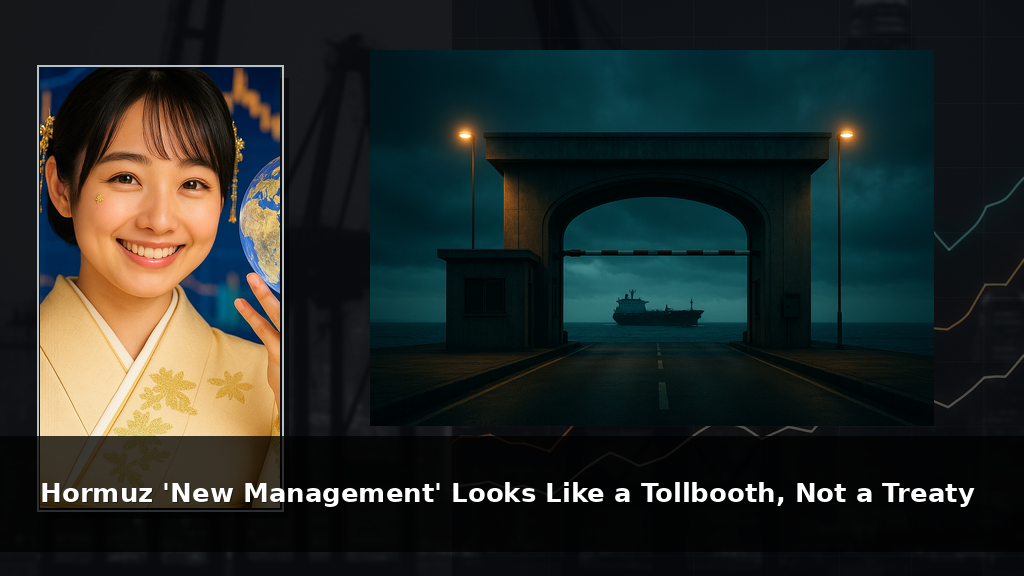
Source: https://x.com/i/status/2049953708004299191
Observation
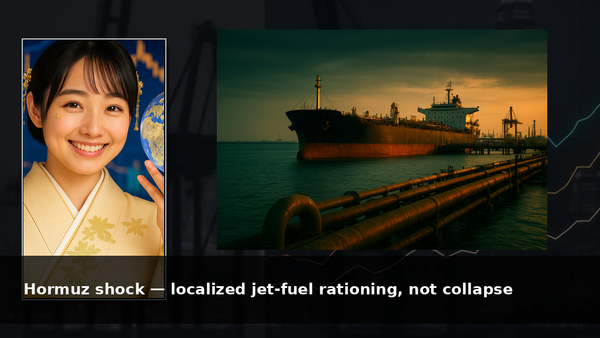
On April 30, 2026, Iran’s new supreme leader, Ayatollah Mojtaba Khamenei, issued a written statement saying Tehran will impose “legal rules and new management” over the Strait of Hormuz, vowing to protect Iran’s nuclear and missile programs and warning foreigners they have no place in the Gulf (per AP/Reuters). Brent crude traded as high as $126/bbl that day, with roughly one-fifth of global crude normally transiting Hormuz (AP). U.S. Central Command (CENTCOM) announced a blockade of ships entering or exiting Iranian ports on April 12, with enforcement beginning April 13, and AP reported some ships were charged about $2 million to pass the strait.
The theme is whether “new management” becomes a coercive gatekeeping regime—vetting, tolls, seizures—or a cooperative, stabilising framework with Gulf partners. It is debatable because the same phrase can mask either outcome, and the stakes—oil flows, insurance pricing, corporate logistics—are immediate and global.
Our stance: for macro portfolio managers (PMs) and Fortune 500 energy procurement leads, hedge for a sustained coercive regime through the next 6–12 weeks and fade headlines implying near‑term normalisation. Only reposition toward a stabilisation trade if escorted convoys or a verifiable Oman‑backed framework materialise.
Geoeconomic Structure
The pushback we hear: a U.S. blockade plus Gulf bypass capacity should blunt Iran’s leverage quickly. That view underestimates how easily a narrow strait converts limited naval assets into decisive gatekeeping and overestimates the speed at which substitutes scale.
First, the chokepoint physics are unforgiving. The Strait of Hormuz compresses tanker traffic into a narrow, surveilled lane; the Islamic Revolutionary Guard Corps (IRGC) Navy can transform that geometry into practical control via vetting, selective boardings, and occasional seizures. Reports that some ships have been charged ~$2 million to pass indicate a monetisation path already in play, not a prospective design. In this setting, “legal rules” function as the wrapper for a toll‑and‑vetting regime that preserves Iran’s escalation ladder while harvesting rents.
Second, counter‑intervention is bounded. CENTCOM’s April 13 blockade enforcement aims to deny Iran port access and deter coercion, but it is not yet an all‑traffic escort program. Unless the U.S. and partners publicly commit to convoying commercial traffic through Hormuz—complete with rules of passage and predictable schedules—the residual risk premium will keep shippers either queuing for Iran‑vetted corridors or avoiding the strait.
Third, substitutes exist but are partial. The UAE’s Habshan–Fujairah line and Saudi’s East‑West Petroline to Yanbu provide real bypass channels, yet they do not instantaneously replace lost Hormuz volumes. A practical test is whether combined Fujairah+Yanbu seaborne loadings can sustain above roughly 3.0 million barrels per day (mbpd); until then, the marginal barrel still prices Hormuz risk. Container and some bulk reroutes via the Panama Canal demonstrate willingness to pay extreme diversion costs, but capacity and drought‑management constraints limit how much relief Panama can offer on short notice.
Finally, insurers are the commercial governor. If Protection and Indemnity (P&I) clubs and Lloyd’s market underwriters continue to price war‑risk but still cover Iran‑vetted transits, many owners will pay up rather than reroute. Only a hard “no‑cover” notice would force a step‑change toward escorted traffic or longer diversions. Until then, the price signal—visible in Brent above $120 and in war‑risk premia—translates Iran’s gatekeeping into sustained global cost.
Put simply: geographic centrality plus an implementer (Islamic Revolutionary Guard Corps Navy, IRGCN) yields a functioning tollbooth. The U.S. blockade and Gulf workarounds are meaningful, but absent escorted convoys or a diplomatic framework with Oman, they mitigate rather than neutralise Iran’s leverage in the near term.
Nine Star Ki Reading
Six White Metal (Roppaku Kinsei, 六白金星) is the star of authority and precision; here, it corresponds to CENTCOM and allied naval command, because they embody disciplined planning and rules‑based enforcement. One White Water (Ippaku Suisei, 一白水星) is the star of flows and networks; here, it corresponds to tanker traffic and the UAE/Saudi export corridors, because they translate operational discipline into restored throughput.
Metal produces Water (kin‑sho‑sui, 金生水), a productive relation: precise, authoritative naval action can catalyse flow. Applied here, that means if CENTCOM shifts from blockade to declared escorted convoys with predictable slots, shipping behaviour could normalise faster than a pure coercion model implies—narrowing Brent’s risk premium and pushing Automatic Identification System (AIS) transponder density back toward baseline within weeks. This does not overturn the tollbooth thesis; it time‑boxes it. The window for Iran to extract rents is open now, but disciplined authority can shorten it abruptly once publicly signalled and executed.
Recommendations
If you are a macro portfolio manager (PM) with energy exposure, position for 6–12 weeks of elevated disruption, but keep dry powder for a sharp reversal if escorted‑convoy signals appear. For a Fortune 500 energy procurement lead, extend coverage and diversify loading points (Fujairah/Yanbu) now, with contingent plans to revert if convoy schedules are published.
- Lloyd’s List Intelligence transit counts: Hormuz tanker transits staying below 30% of pre‑war baseline over the next 4 weeks confirm the coercive‑regime thesis; a rebound above 50% weakens it.
- Abu Dhabi National Oil Company (ADNOC) + Saudi Aramco seaborne loadings: combined Fujairah+Yanbu sustained above 3.0 million barrels per day (mbpd) for 30 consecutive days reduces Iran’s leverage; below that supports our stance.
- Intercontinental Exchange (ICE) Brent front‑month: persistent >$120/bbl or a fresh >10% jump on Hormuz headlines within 3 trading days signals markets still pricing sustained supply risk.
- P&I/Lloyd’s advisories: issuance of a named “Strait of Hormuz” war‑risk surcharge or a hard no‑cover notice would force reroutes; absence supports Iran‑vetted passage and rent extraction.
Caveats and Open Questions
- Oman signs on: if Muscat publicly endorses a joint Hormuz management framework with Iran (Ministry of Foreign Affairs, MFA, release or a memorandum of understanding, MoU) within the next 12 months, the regime shifts from unilateral tolling to partial legitimation, undermining our tollbooth call.
- Gulf throughput surges: if ADNOC and Saudi Aramco rapidly lift combined Fujairah+Yanbu loadings above 3.0 mbpd and hold it, bypass capacity would erode Iran’s marginal leverage faster than we project.
- Insurers harden: if major P&I clubs or Lloyd’s syndicates publish a hard no‑cover stance for Iran‑vetted transits, many owners would be forced into escorted convoys or diversions, shortening the disruption window.
Focused question: Which actor moves first to break the tollbooth—CENTCOM announcing escorted convoys, Oman publishing a coordination framework, or Lloyd’s/P&I issuing a hard no‑cover notice—and are you positioned for the one that actually materialises?